
Name Meaning
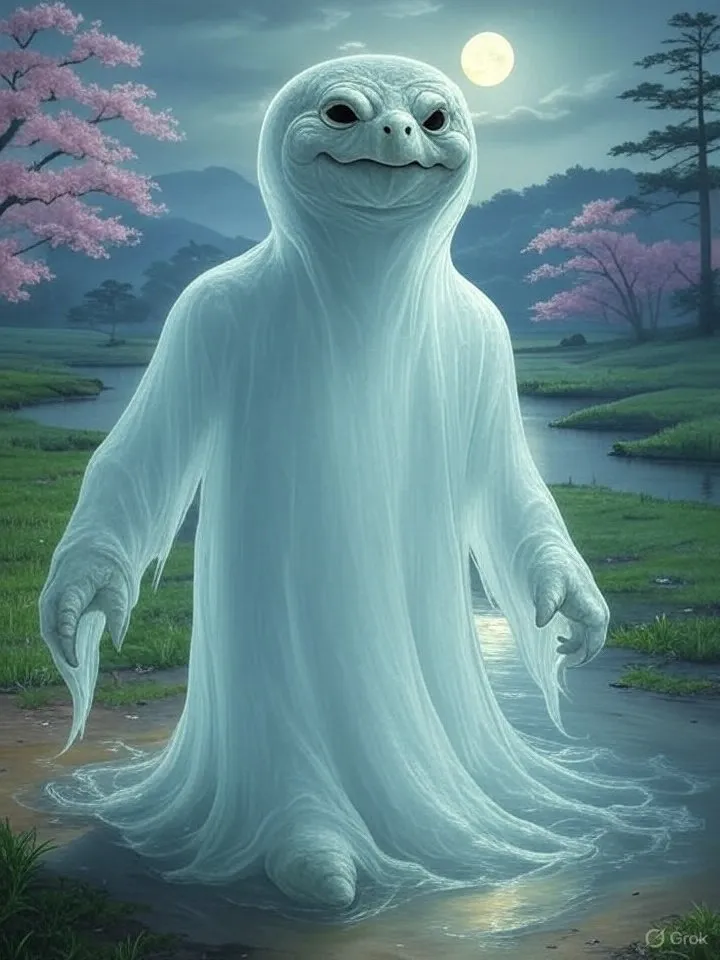
Suppon-no-yūrei (すっぽんの幽霊) refers to a ghostly figure whose face resembles a suppon, or soft-shelled turtle, giving it a bizarre and unsettling appearance.
- Suppon (すっぽん) = Soft-shelled turtle
- Yūrei (幽霊) = Ghost
Origin
- This yokai stems from humorous or grotesque ghost stories and images in Edo-period art.
- It may also reflect cultural associations between turtles and odd or haunting appearances.
Appearance
- Has a human-like form with a ghostly body.
- Its face is eerily flat and rounded like a soft-shelled turtle.
- May appear dripping wet or in a mist, adding to its spectral nature.
Behavior & Myths
- It haunts those who have wronged it in life or defiled nature.
- Sometimes appears near rivers, bridges, or abandoned inns.
- May be silent or emit eerie groans like wind or bubbles.
Symbolism
- Reflects grotesque humor and creativity in ghost imagery.
- Symbolizes the strange boundary between humans and animals in yokai lore.
- May serve as a warning against mocking or abusing even strange-looking creatures.

Illustrated folktale
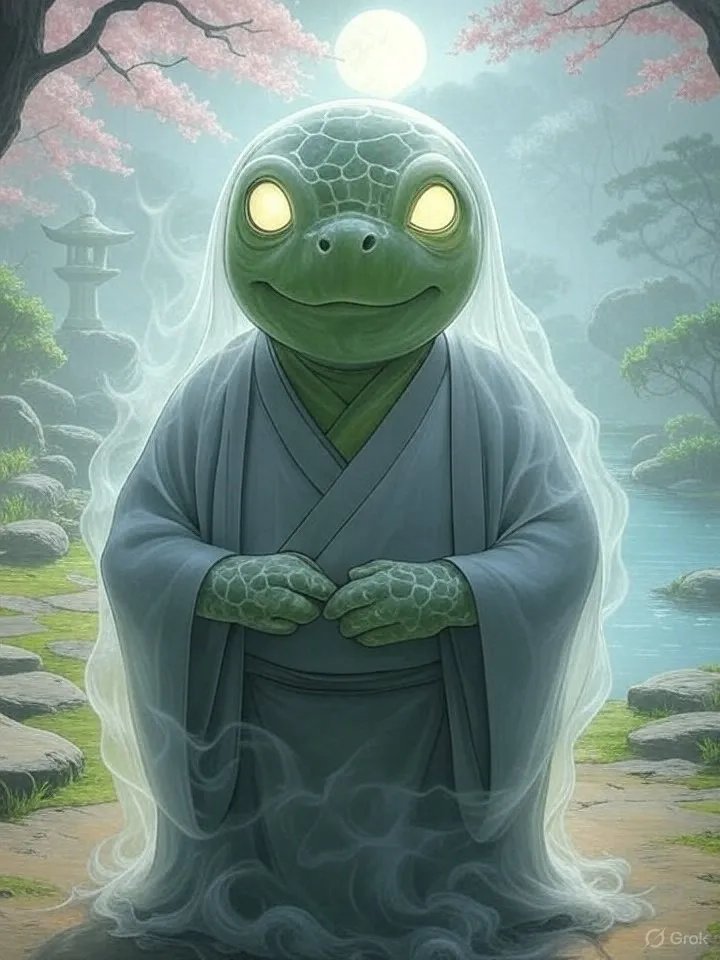
The tale of Suppon-no-yūrei

In the mist-shrouded valleys of rural Akakawa, there stood an ancient bridge, its weathered stone pilings worn smooth by the gentle flow of the Kiso River. Locals whispered of a spirit that haunted the bridge's shadowy corners, a creature with the face of a turtle and the body of a ghost.
They called it Suppon-no-yūrei, a name that sent shivers down the spines of even the bravest villagers. Few claimed to have seen it, but those who had spoke of an unearthly silence that accompanied its presence – as if the very air itself was holding its breath in anticipation of some unseen movement.
One autumn evening, a young apprentice fisherman named Kaito crossed the bridge on his way back from a long day's work. His thoughts were consumed by the troubles at home: his mother's failing health and the dwindling catches that had put their family's livelihood at risk. As he walked, the moon rose high in the sky, casting an eerie glow over the water.
It was then that Kaito saw it – a figure perched on the bridge's edge, its flat face tilted upwards as if drinking in the mist that swirled around its feet. The creature's eyes, two empty holes of shadow, seemed to stare right through Kaito. For an instant, their gazes locked, and Kaito felt a strange calm wash over him.
The next morning, villagers reported seeing Kaito standing at the bridge's edge, his face as white as the mist that clung to the stone pilings. He was motionless, staring out into the void as if mesmerized by some unseen force. Some said he was under the creature's spell, while others whispered that he had seen something terrible – a glimpse of his own mortality.
Days passed, and Kaito remained frozen at the bridge. His mother grew concerned, sending out her sister to tend to him. The old woman arrived just as night was falling, lantern in hand, and found Kaito's form still as stone.
As she approached, the wind began to pick up, rustling the reeds that grew near the riverbank. Strange, gurgling sounds echoed through the valley – not quite a laugh, nor quite a sigh. The old woman shivered, feeling the weight of the Suppon-no-yūrei's presence like a cold, wet shroud.
With trembling hands, she reached out and touched Kaito's shoulder. His eyes snapped open, filled with a deep sadness that seemed to mirror the creature's own vacant stare. "My son," his mother's sister whispered, "you have seen the face of your own decline – and that of our village."
Kaito nodded slowly, as if awakening from a long, troubled sleep. Together, they walked away from the bridge, leaving behind the haunting whisper of bubbles rising to the surface of the Kiso River – a reminder of the Suppon-no-yūrei's ghostly form, lingering in the mist-shrouded valleys, waiting for its next victim.