
Name Meaning
Overview
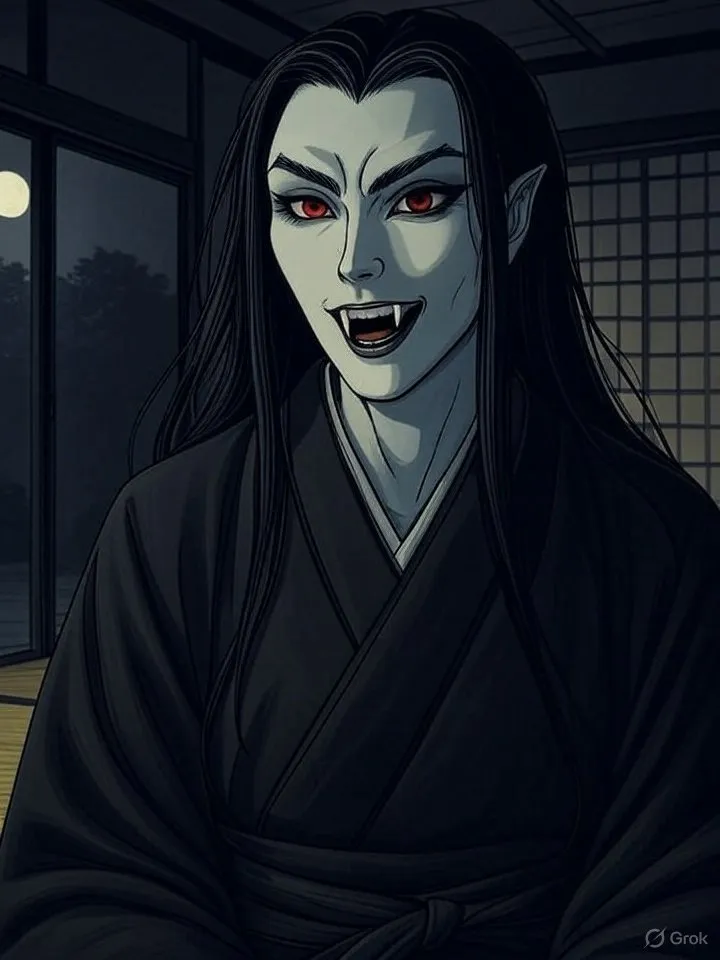
Kyūketsuki (吸血鬼) literally means “blood-sucking demon” and is the Japanese adaptation of the Western vampire mythos.
- Kyū (吸) = to suck
- Ketsu (血) = blood
- Ki (鬼) = demon
Origin
- Introduced through translations and media in the Meiji era and beyond.
- Inspired by European vampire legends but adopted into local horror and pop culture.
- Associated with themes of Westernization and modern fears.
Appearance
- Typically depicted as pale, fanged, and charming—similar to Western vampires.
- May wear Western-style clothing or Japanese attire depending on the setting.
- Sometimes portrayed as ghostly or demonic.
Behavior & Myths
- Feeds on the blood or life energy of the living.
- May be repelled by Buddhist charms, sunlight, or sacred grounds.
- Often featured in anime, literature, and horror fiction with a Japanese twist.
Symbolism
- Represents fear of disease, death, and foreign influence.
- Seen as seductive, mysterious, and dangerous beings.
- Blends old-world superstition with new-world horror.
Kyūketsuki vs Western Vampires
Although the word Kyūketsuki is used to translate "vampire" in modern Japanese, the creature has notable differences from its European counterpart:
| Feature | Kyūketsuki | Western Vampire |
|---|---|---|
| Origin | Western import, Meiji era | Eastern European folklore |
| Weakness | Sunlight, Buddhist sutras, ofuda | Garlic, crosses, sunlight |
| Transformation | Bat, mist, or shadow forms | Bat, wolf, mist |
| In anime/manga | Very prominent (Hellsing, Vampire Knight) | Referenced, not native |
Kyūketsuki in Anime & Manga
The Kyūketsuki archetype has become one of the most popular supernatural figures in Japanese popular culture:
- Hellsing (ヘルシング): Alucard is the most iconic anime Kyūketsuki — a vampire who works for a British organization hunting supernatural threats.
- Vampire Knight (ヴァンパイア騎士): Follows vampire students at a prestigious academy, blending romance with Kyūketsuki mythology.
- That Time I Got Reincarnated as a Slime: Features vampire characters with traditional Kyūketsuki traits.
- Rosario + Vampire: A comedic take on Japanese vampire culture at a monster school.
Native Japanese Blood Spirits — Before Kyūketsuki
Before the Western vampire concept arrived in Japan, native folklore had its own blood or life-draining spirits:
- Nikusui (肉吸) — Drains flesh and blood from sleeping victims
- Nukekubi (抜け首) — Flying head that feeds on blood at night
- Hone-onna (骨女) — Skeletal woman who slowly drains her lover's life force
- Jubokko (樹木子) — A tree that grew on a battlefield and learned to feed on human blood

Illustrated folktale
The tale of Kyūketsuki

In the mist-shrouded mountains of Kii Province, where the cedar forests whispered secrets to the wind, there lived a young woman named Emiko. Her eyes were like the night sky, dark and deep, and her skin was as pale as the moon on a winter's eve.
Emiko had always felt an inexplicable connection to the shadows. As a child, she would sneak out of her family's temple at dawn, when the dew-kissed grass sparkled like diamonds, and walk among the trees, feeling their ancient wisdom coursing through her veins.
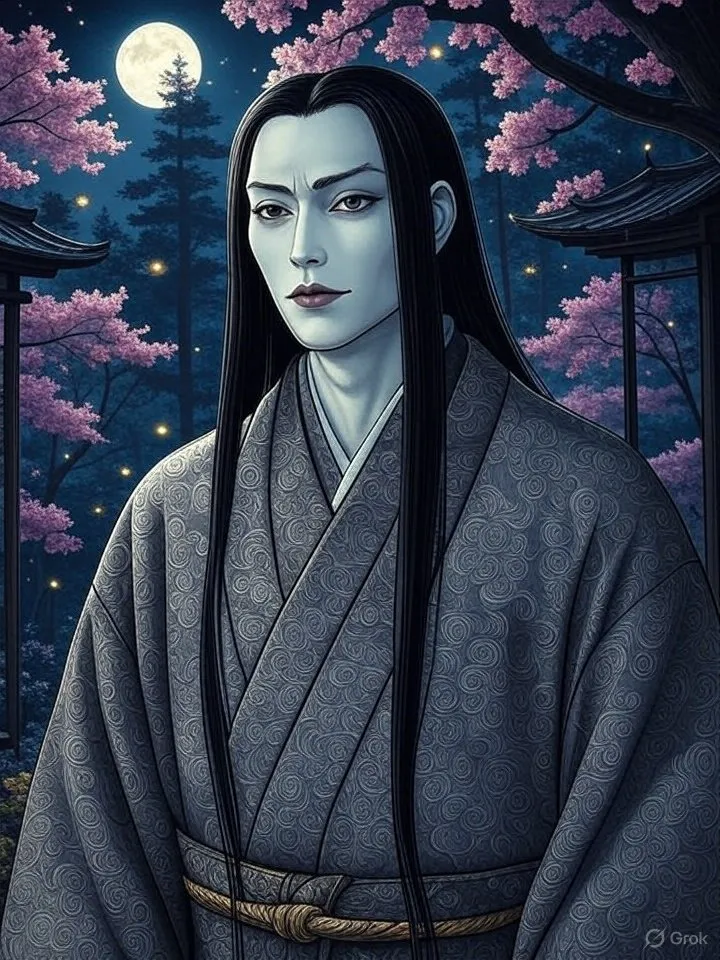
One autumn evening, as Emiko wandered deeper into the forest than she had ever gone before, she stumbled upon a strange and wondrous sight: a garden of blooming cherry blossoms in full glory, surrounded by the twisted limbs of an old cedar. The air was heavy with the scent of blood and damp earth.
As Emiko approached, a figure emerged from the shadows – a man with eyes like polished onyx, his skin deathly pale, and lips that curved into a cruel smile. He wore a black kimono embroidered with silver threads, which seemed to shimmer in the fading light.
"Kimi wa kūketsuki no mono," he whispered, his voice like a summer breeze rustling through dry leaves. "You are one of us, Emiko-chan."
Emiko felt an icy dread creeping up her spine as she realized that this was no ordinary man. He offered her a hand, and with it, a taste of the very essence of life: a drop of his own blood on her tongue.
In that moment, Emiko knew she had become one of the Kyūketsuki – feeders of the living's life force, bound to their cursed existence by an eternal thirst. As the darkness deepened, and the forest grew quiet, Emiko felt herself merge with the shadows, becoming as elusive and seductive as the night itself.
The next morning, her family awoke to find Emiko vanished, leaving behind only a faint scent of cherry blossoms and a whispered rumor: that on certain nights, when the moon hung low in the sky, she could be seen strolling through the forest's twilight realm, searching for her own kind, forever bound to the shadows.
In time, people began to speak of Emiko as a Hone-onna – a skeletal woman who drained the life from her lovers with each passing night. They whispered that on certain moonlit nights, one could hear her whispers echoing through the forest: an eerie melody of longing and despair, forever tied to the shadows she now called home.
As the seasons passed, Emiko's legend grew, becoming woven into the fabric of local myth and superstition. But those who knew the truth whispered that on rare occasions, when the moon hung low in the autumn sky, they could still see her strolling through the forest – a pale, beautiful woman with eyes like the night sky, forever lost to the shadows that now cradled her like a lover's arms.