
Name Meaning
Overview
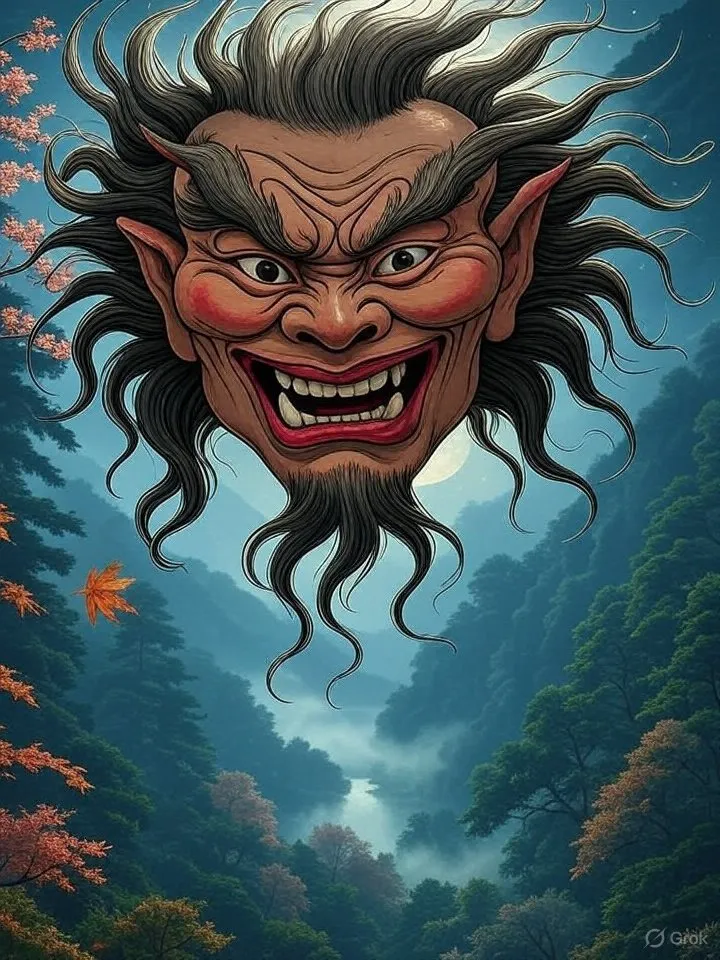
Nukekubi (抜け首) means "detached head" in Japanese. This yokai appears as a normal person during the day, but at night, its head separates and flies off to terrorize humans.
- Nuke (抜け) = to detach or escape
- Kubi (首) = head or neck
Origin
- Often confused with Rokurokubi, but Nukekubi heads fully detach and fly independently.
- Legends describe them disguising themselves as normal people to avoid detection.
- Frequently appear in Edo period ghost stories and kaidan collections.
Appearance
- Human body with no obvious signs during the day.
- At night, the head detaches and floats or flies away.
- Eyes glow red while hunting or feeding.
Behavior & Myths
- Fly through the night in search of sleeping victims.
- Attack by biting or screaming to instill fear.
- If their head cannot return to the body by morning, they die.
Symbolism
- Embodies hidden malice behind normal appearances.
- Warns of trusting strangers or those who conceal their true nature.
- Sometimes used in horror stories to symbolize uncontrollable urges or dual identities.
Nukekubi vs Rokurokubi: The Confusion
These two yokai are often confused, but have distinct differences:
| Feature | Nukekubi (抜け首) | Rokurokubi (轆轤首) |
|---|---|---|
| Head Behavior | Completely detaches | Neck stretches |
| Mobility | Flies independently | Remains connected via neck |
| Danger Level | More dangerous (drinks blood) | Less dangerous (mostly harmless pranks) |
Protection and Weakness
According to folklore, there are several ways to protect yourself or defeat a Nukekubi:
- Hide the body: If you find the sleeping body while the head is detached, move or hide it. The head cannot reattach and will die at sunrise.
- Mark the neck: Drawing marks on the neck while the person sleeps can prevent transformation.
- Stay indoors at night: Nukekubi primarily hunt outdoors after dark.
Nukekubi in Modern Media
- Horror Films: Featured in Japanese horror cinema
- Anime: Appears in "Nura: Rise of the Yokai Clan"
- Video Games: Boss or enemy in various Japanese horror games

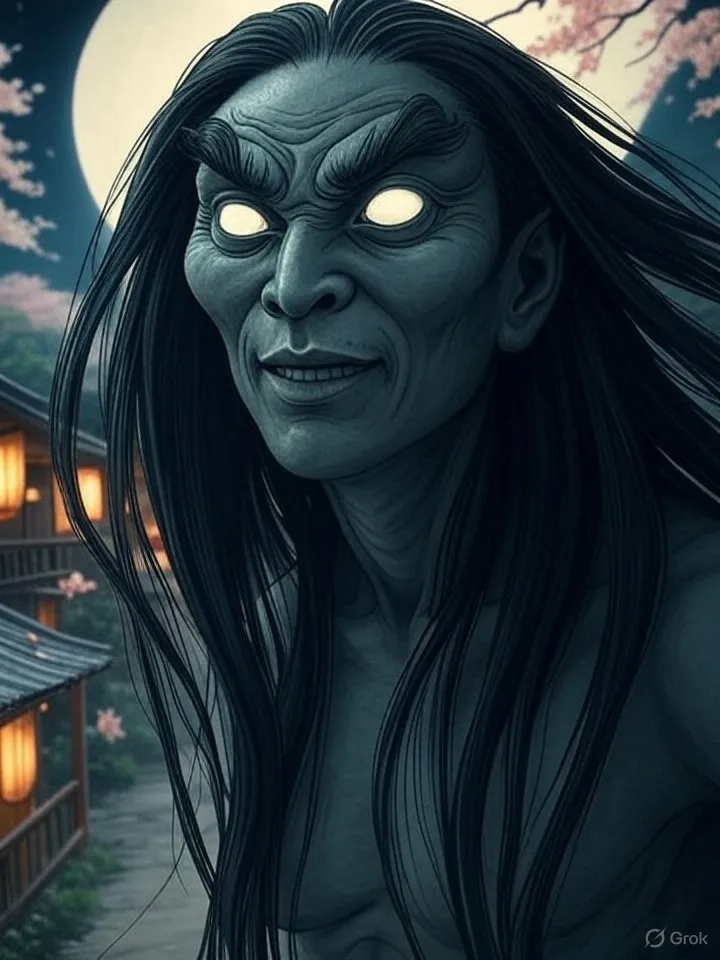
Illustrated folktale
The tale of Nukekubi

In a small village nestled between two great mountains, there lived a humble rice merchant named Kaito. He was known for his kind heart and generosity to travelers who passed through the village. His wife, Emiko, was equally well-respected for her skill in weaving beautiful silk fabrics.
One autumn evening, as the sun dipped below the western peak, Kaito returned home from a long day's journey. Exhausted, he lay down on his futon, exhausted by the weight of the heavy bundles of rice he had carried that day. Emiko, sensing his fatigue, decided to let him sleep while she worked on her latest weaving project.
As night descended, the village grew quiet, except for the distant howling of wolves and the rustling of leaves in the wind. Kaito's wife went about her work, unaware of the presence that lurked beyond the village limits. The moon had not yet risen high in the sky when a faint humming noise began to echo through the streets.
It started as a gentle buzz, but soon grew into a blood-curdling scream. The wind carried the sound towards Kaito's home, where Emiko was busy with her loom. As she worked, the scream seemed to grow louder, more anguished, until it became almost unbearable.
Emiko stopped weaving and listened intently. She thought of Kaito sleeping peacefully, oblivious to the terror that surrounded them. A chill ran down her spine as she realized what might be happening outside their home.
Without hesitation, Emiko rushed towards Kaito's futon. She found him lying still, but with a subtle change in his expression – a faint tremor of fear had settled on his face. That was when she noticed the dark shapes flitting about the room.
As if summoned by her presence, they began to materialize before her eyes: Nukekubi heads, each one detached from its owner's body and flying about with an otherworldly light in their eyes. The heads swooped closer, their red orbs fixed on Emiko as they let out a collective wail.
She knew that these malevolent spirits were the true horror of the night – beings who preyed upon the innocent while hiding behind masks of normalcy. If left unchecked, they would feast on Kaito's life force, leaving his body cold and still by dawn.
With swift thinking, Emiko grabbed a small wooden comb from her sewing box and drew a series of intricate marks across Kaito's neck. The Nukekubi heads recoiled at the sight, their glow dimming in protest.
Their cries echoed through the night, growing fainter as they flew away into the darkness, defeated by Emiko's quick thinking. The villagers below stirred, but none dared venture out to confront the departing spirits. It was said that on nights like these, the Nukekubi's power was at its peak – and their presence was a warning for all who would listen.
When morning broke, Kaito woke with a start, feeling refreshed despite his troubled dreams. He smiled up at Emiko as she tended to her loom, grateful for her watchful care during the long night ahead. Little did he know that his wife had shielded him from a terror beyond comprehension – and that their home was now marked by the subtle signs of protection against such evil entities.
From that day forward, travelers passing through the village would whisper stories of Emiko's cunning and Kaito's lucky stars. And though the Nukekubi continued to roam at night, their malevolent presence seemed a little less formidable in a world where courage and wit could stand against even the most fearsome of spirits.