
Why cats become yokai
Cats have always seemed a little uncanny: silent, night-eyed, independent, at home in temples and graveyards. Japanese folklore turned that into a rule — a cat that lives unusually long, grows unusually large or is badly treated can change into something else.
- It learns to talk and walk on its hind legs.
- It changes shape, most often into a woman, sometimes after killing her.
- Its tail splits in two, the sign of the most powerful cat yokai, the nekomata.
The fear is old: a mountain nekomata already turns up in the 14th-century essays Tsurezuregusa. In the Edo period, kabuki and woodblock prints filled with monster cats, and a cat dancing on its hind legs became one of the classic yokai images.
The kanji for cat
Most cat yokai carry the kanji 猫 (neko, cat) in their name — bakeneko 化け猫 (“changed cat”), nekomata 猫又 (“forked cat”), nekomusume 猫娘 (“cat girl”). The fiery kasha is the exception: its name, 火車, means “fire cart”.
The lucky cat: maneki-neko
Not every Japanese cat is a monster. The maneki-neko (招き猫), the beckoning cat in shop windows, is a charm for good fortune and customers. One of its best-known origin stories belongs to Gōtoku-ji, a temple in Setagaya, Tokyo, where a cat is said to have waved a passing lord inside just before a storm broke — the temple is now filled with thousands of small white beckoning cats left by visitors.
Where to meet Japan’s cats
- Gōtoku-ji, Tokyo — the beckoning-cat temple described above.
- Tashirojima, Miyagi — the “cat island” off Ishinomaki, where cats outnumber people and a small shrine honours them.
Below are the cat yokai of Japanese folklore, from the shape-shifting bakeneko to the leg-rubbing sunekosuri.
5 cat yokai
-
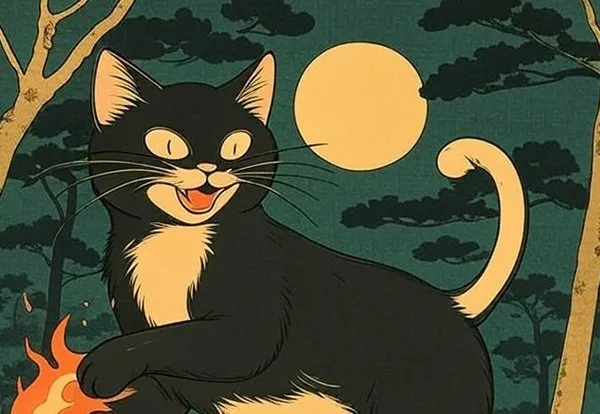 1.
Bakeneko
化け猫
The “changed cat” (化け猫): a pet that has lived unusually long and turned supernatural. It can talk, walk on two legs and take human form — an old woman or a beautiful young one — and in some stories dances with a napkin on its head. The Nabeshima legend made it Japan’s most famous monster cat.
Read about Bakeneko →
-
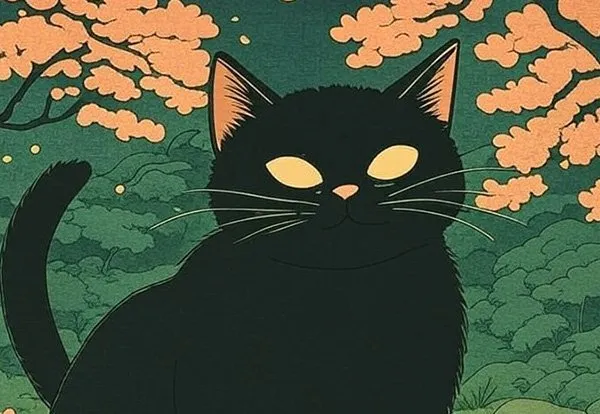 2.
Nekomata
猫又
The “forked cat” (猫又): a very old cat whose tail has split in two. More powerful than a bakeneko, it is said to raise and control the dead, and to curse owners who treated it cruelly.
Read about Nekomata →
-
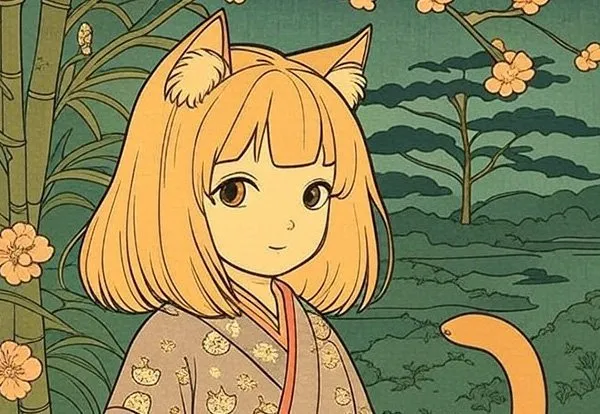 3.
Nekomusume
猫娘
The “cat girl” (猫娘): a girl with a cat’s ears, eyes or tail, from kabuki and Edo-period tales — sometimes protective, sometimes sinister. Today she is best known as Neko-Musume in GeGeGe no Kitarō.
Read about Nekomusume →
-
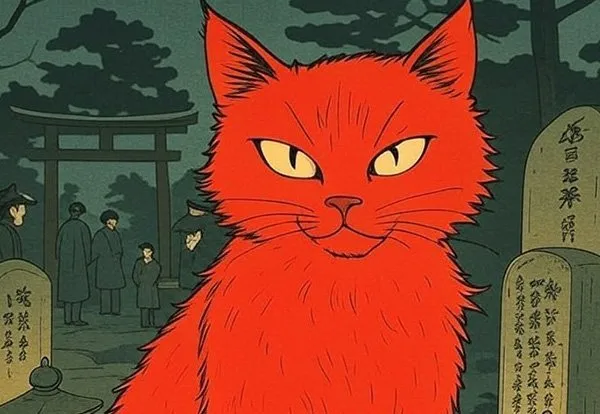 4.
Kasha
火車
The “fire cart” (火車): a monstrous, flaming cat that comes down from the sky during funerals to steal the bodies of the wicked, feared for disrupting Buddhist funerals and cremations.
Read about Kasha →
-
 5.
Sunekosuri
すねこすり
The “leg-rubber” from Okayama: a small, soft creature like a cat or a dog that brushes against your legs on dark, often rainy nights and trips you up. Playful rather than dangerous.
Read about Sunekosuri →
Questions
- What is a bakeneko?
- A bakeneko (化け猫, “changed cat”) is a cat that has become a yokai, usually by living to a great age. It can speak, walk upright and shape-shift into a person.
- What is the difference between a bakeneko and a nekomata?
- Both are cats turned supernatural. A nekomata (猫又) is marked by a tail split into two and is usually seen as older and more powerful — able to control the dead — while bakeneko is the broader word for any monster cat.
- Why do some Japanese cats have short tails?
- The Japanese bobtail’s short tail is a natural breed trait. Folklore adds its own explanation: a short tail cannot split in two, so a cat without a long tail could never become a nekomata.
- Is the maneki-neko a yokai?
- No. The maneki-neko, the beckoning cat, is a lucky charm rather than a monster. One of its best-known origin stories comes from Gōtoku-ji temple in Tokyo, where a cat is said to have waved a passing lord inside just before a storm.
Learn Japanese
Read about yokai in Japanese
Readers, books and study bundles from The Japan Shop.
-
 Learn Japanese with Yokai
Japanese readers about yokai, with furigana and native audio (JLPT N4 level).
See at The Japan Shop →
-
 Hikoichi: A Japanese Folktale Reader
Four short tales about the trickster Hikoichi, written for learners of Japanese.
See at The Japan Shop →
-
 Japanese Culture Bundle
Digital books on Japanese culture, with the vocabulary to go with it.
See at The Japan Shop →
Sponsored links. We may earn a commission if you buy, at no extra cost to you.