

Name Meaning
Overview
Soraki-gaeshi (空木返し) refers to a strange auditory yokai phenomenon. It literally means "hollow tree echo" or "phantom tree-felling."
- Sora (空) = sky or emptiness
- Ki (木) = tree
- Gaeshi (返し) = return, reversal, or echo
Origin
- Recorded in rural forested regions of Japan, especially in the mountains.
- Appears in oral traditions as a warning or unsettling sign from the spirit world.
- Sometimes linked to restless forest spirits or angry kodama.
Appearance
- This phenomenon has no visible form—only the sound is experienced.
- Witnesses describe the sound of heavy axes striking wood, trees crashing down.
- When investigated, no signs of tree damage are found.
Behavior & Myths
- Considered an omen, sometimes foretelling misfortune or spiritual unrest.
- May be attributed to invisible yokai disturbed by humans or disrespect of nature.
- Some believe it is a test of reverence for the forest gods or spirits.
Symbolism
- Symbolizes unseen forces of nature and the spiritual essence of forests.
- Represents the mysterious and the unexplained in daily life.
- Acts as a reminder to respect and not desecrate sacred woodland areas.

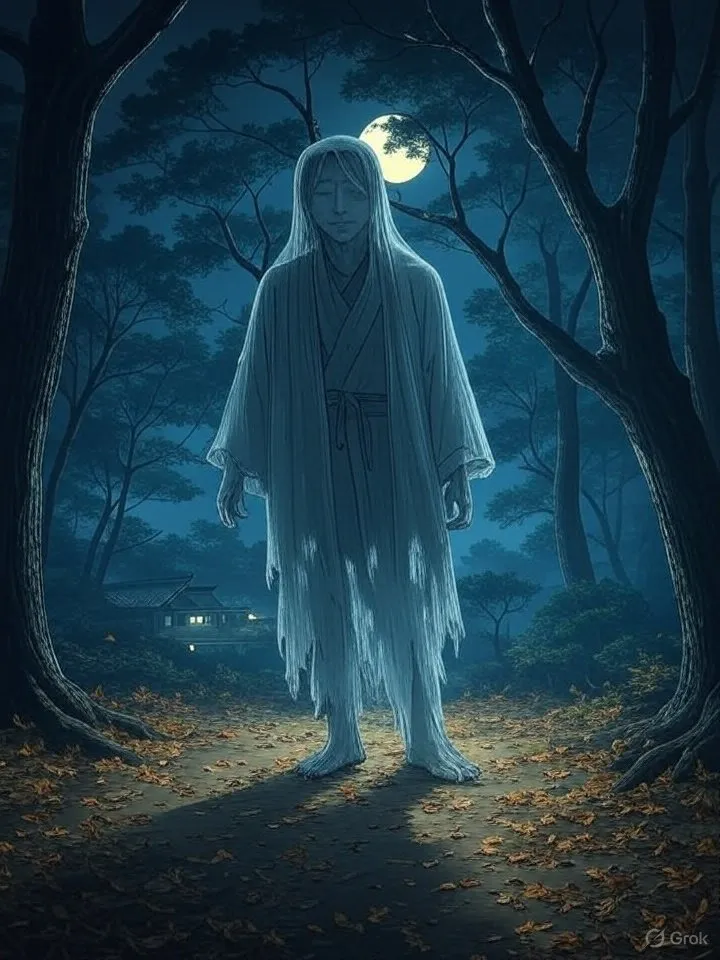
Illustrated folktale
The tale of Soraki-gaeshi

Deep in the mountains, where the forest whispered secrets to the wind, there lived a young man named Kaito. He was a woodcutter, skilled with an axe and respected by his village for his hard work and gentle soul. Yet, as winter's chill began to bite, Kaito's thoughts turned to the forest's vast expanse, where ancient trees stood tall like sentinels.
One evening, as he prepared to return home, Kaito heard it – the unmistakable sound of axes striking wood, followed by the crash of splintering timber. He stopped in his tracks, axe raised, and listened intently. The pounding grew louder, yet no tree fell before him. Confused, he cautiously approached the source, expecting to see a rival woodsman at work.
But there was none. No fallen trees, no visible signs of disturbance. Only an unsettling stillness hung over the forest like a shroud.
As Kaito returned to his village that night, the sound recurred – heavy axes striking wood, then the disorienting crash. Fearing something amiss, he confided in the elder woodsman, Hiroshi, who listened with a knowing gaze.
"Hush, Kaito," Hiroshi said, his voice barely audible above the crackle of the fire. "The Soraki-gaeshi awakens."
Kaito's eyes widened as Hiroshi continued. "It is a sign from the forest spirits, warning us of their displeasure. We must respect their domain and remember to offer reverence at the sacred groves."
Intrigued by Hiroshi's words, Kaito felt an eerie presence lurking within the trees. He realized that his own carelessness had disturbed the balance – a fallen branch left untended, a careless prayer offered without heart.
Determined to right the wrongs of the past, Kaito returned to the forest at dawn, carrying a bundle of sacred offerings: incense, sake, and a handmade wooden figurine. As he approached the spot where the Soraki-gaeshi had struck, he felt an unseen weight lift from his shoulders.
The sound ceased. The trees stood still, their branches creaking softly in the morning breeze. From that day forward, Kaito made sure to honor the forest spirits with due reverence and care for the land. His axe strikes were gentle as a lover's caress, and his footsteps quiet as a ghost's.
As winter melted into spring, the village prospered, and Kaito's woodcraft was sought by neighboring towns. And though he heard the Soraki-gaeshi no more, its presence remained within him – an unshakeable awareness of the unseen forces that whispered through the trees.