
Name Meaning
Overview
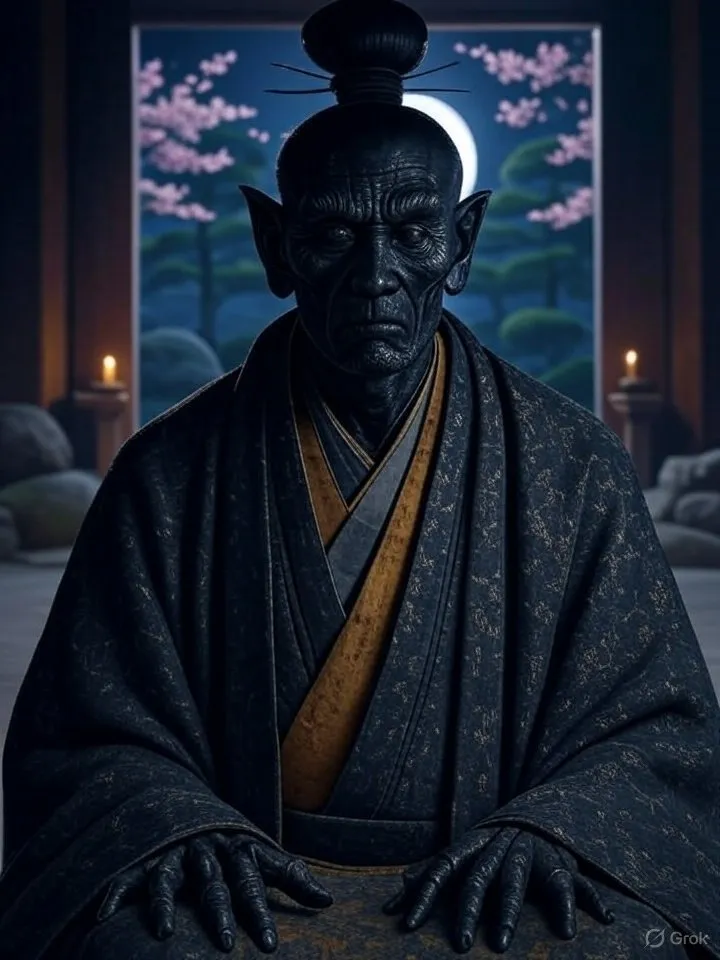
Nuribotoke (塗仏) can be translated as "lacquered Buddha" or "painted corpse," a name that ironically reflects its ghoulish appearance.
- Nuri (塗) = painted or lacquered
- Botoke (仏) = Buddha or departed soul
Origin
- Found in Edo-period yokai picture scrolls and ghost stories.
- Linked with eerie events around Buddhist altars in homes.
- Its image invokes death, decay, and spiritual corruption.
Appearance
- Appears as a decaying human body with darkened skin.
- Its eyeballs dangle grotesquely from the sockets.
- May emerge from household altars in the night.
Behavior & Myths
- Silently appears and vanishes, instilling horror in the viewer.
- Associated with forgotten prayers or neglected altars.
- Some tales describe it stealing offerings or glaring menacingly at guests.
Symbolism
- Represents death improperly honored or spirits denied peace.
- Warns against neglecting familial or religious duties.
- A visual reminder of mortality and spiritual balance.

Illustrated folktale
The tale of Nuribotoke

In the village of Shinmachi, where the misty dawn crept over the thatched roofs, there lived an old man named Kaito. His wife had passed away several years ago, and since then, Kaito had taken upon himself the duty of tending to their family's ancestral altar in their humble home. He would offer incense, candles, and fresh vegetables every morning, making sure his loved one was never forgotten.
However, as time went by, Kaito began to neglect his duties. The chores piled up, and he found himself busy with other tasks. One evening, while hurrying through the kitchen, he knocked over a box of offerings meant for his wife's memorial day. Food spilled on the floor, and incense sticks scattered about.
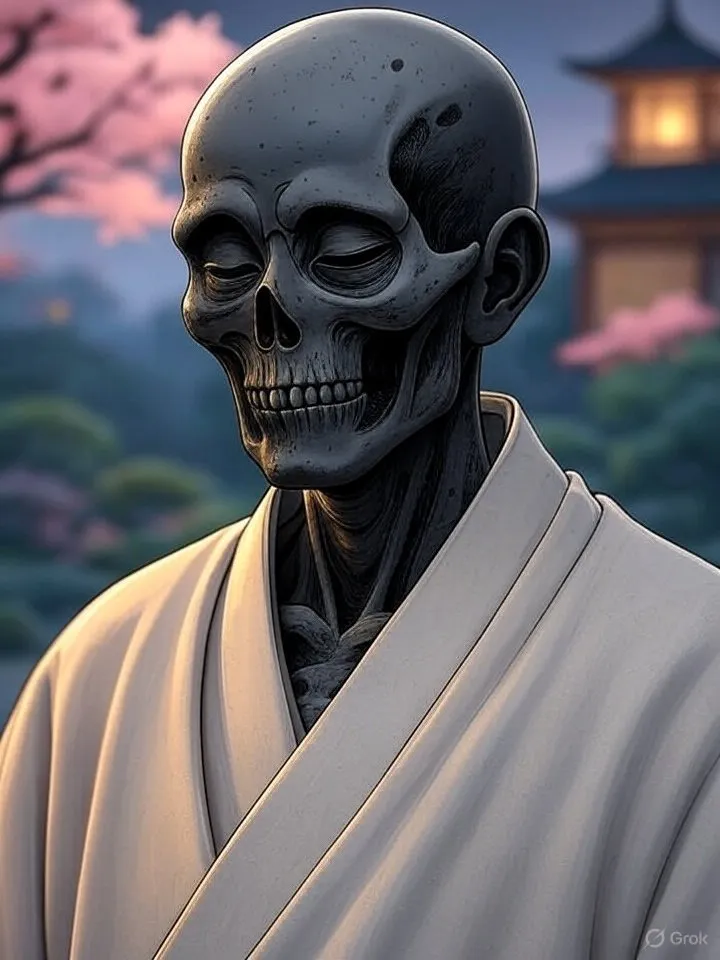
The night fell like a shroud over Shinmachi. The villagers retired to their homes, unaware of the presence lurking within Kaito's dwelling. As the clock struck midnight, an unseen force stirred in the darkness. From the ancestral altar, a putrid stench wafted out into the night air. A figure began to take shape – Nuribotoke, with skin as black as coal and eyeballs that hung like lanterns from their sockets.
It rose, silent as a phantom, from the altar, its presence seeming to draw in the very shadows themselves. The darkness around it grew thicker, like a palpable mist. As Nuribotoke moved, the air seemed to vibrate with an otherworldly energy – an aura that repelled all who crossed its path.
Kaito, oblivious to the danger lurking within his own home, lay asleep in his futon. His neglect of the ancestral altar had brought about this abomination. The Nuribotoke drifted closer to him, its malevolent gaze lingering on the sleeping form. It seemed to be studying Kaito with an unspeakable curiosity.
Without warning, the figure vanished into thin air, leaving behind only a faint scent of decay and a whispered rumor that echoed through Shinmachi: "Kaito's wife still waits for his care." The villagers spoke little of it, but they knew that when the moon was full and the night grew dark, Kaito would see the Nuribotoke again. Each time, its presence reminded him of his forgotten duties – a haunting that seemed to draw closer with each passing month.
As for Kaito, he awoke from his slumber, sensing an unseen weight upon his chest. He stumbled out of bed and made his way back to the ancestral altar. There, amidst the scattered incense sticks and offerings, he found a faint inscription on a piece of washi paper: "Respect the departed." The words seemed to burn with an otherworldly fire in the dim light of dawn.
From that day forward, Kaito tended to his wife's altar with renewed dedication. The villagers noticed a change in him – a quiet reverence for the duties he had once neglected. And though the Nuribotoke never reappeared, its presence remained, a reminder to honor the dead and maintain balance within one's soul.