
Name Meaning
Overview
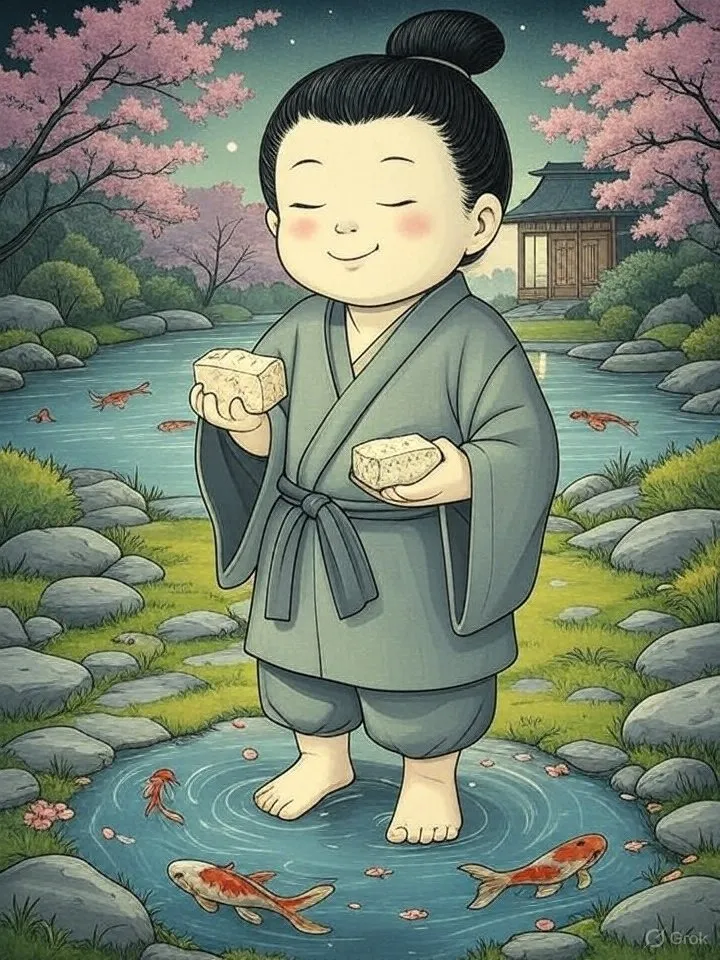
Tōfu-kozō (豆腐小僧) means "Tofu Boy" or "Little Tofu Child," referencing the tray of tofu the yokai carries.
- Tōfu (豆腐) = Tofu
- Kozō (小僧) = Young boy or child servant
Origin
- Originates from Edo-period artwork and stories.
- Frequently appears in haunted house tales or alongside more powerful yokai.
- May have been used to scare children into obedience.
Appearance
- Depicted as a small, bald-headed child in traditional clothing.
- Always carries a tray with tofu, sometimes with mold growing on it.
- Usually harmless in demeanor.
Behavior & Myths
- Stands silently offering tofu to passersby.
- Often considered a minor yokai used for comedic or eerie effect.
- Some stories say accepting his tofu brings illness.
Symbolism
- Represents innocence with a subtle undertone of unease.
- Embodies how mundane objects can become eerie in the right context.
- Sometimes linked to other yokai like nurarihyon or umbrella spirits.


Illustrated folktale
The tale of Tōfu-kozō

In the depths of autumn, when mist crept over the sleepy village, a lone traveler chanced upon a forsaken estate. The once-grand mansion loomed before him, its wooden pillars shrouded in vines and ivy, like nature itself sought to conceal its secrets.
The traveler's footsteps echoed through the empty halls as he searched for shelter from the chill evening air. That was when he spotted the Tōfu-kozō, perched on a stool beside the entrance, its bald head reflecting the flickering moonlight.
In his small hands, the child yokai held a wooden tray adorned with an assortment of tofu cubes, some beset by the faint mold that bloomed like tiny lotus flowers. The air around him was heavy with the scent of fermented soybeans and damp earth. The traveler hesitated for a moment before approaching the offering.
The Tōfu-kozō's eyes remained fixed on some point beyond the visitor, as if lost in contemplation. Its small lips moved silently, whispering an unspoken greeting that only the wind could hear. The tray, however, seemed to tremble ever so slightly, as if the child yokai was awaiting a response.
The traveler hesitated, unsure whether to accept the offering or flee into the night. Something about the stillness of the moment and the Tōfu-kozō's unyielding silence captivated him. With hands that seemed to move of their own accord, he reached out and picked up a single cube from the tray.
The mold on its surface glistened with dew as it rested in his palm. A sudden shiver ran through the traveler's body, but not from the chill wind outside. He raised the tofu to his lips, and for an instant, his thoughts were consumed by memories of his mother's cooking, the smell of steaming dishes wafting from their kitchen long ago.
When he opened his eyes again, the Tōfu-kozō was gone, vanished into the shadows like a phantom. The tray remained behind, but it too had changed: now its surface seemed to ripple and undulate as if water were poured upon it. In the distance, a faint cry echoed through the empty halls – not the cry of a human, but something more akin to the wail of a lost bird.
The traveler stood frozen, his hand still raised in mid-air, tofu clutched within its folds. He knew he should flee, that to linger any longer would invite some unwholesome presence into his world. But his feet seemed rooted to the spot, and as night deepened around him, a feeling of disquiet began to spread through his very being.
Years would pass before the traveler recalled the events in that forsaken mansion, but the memory of the Tōfu-kozō's offering remained with him – an unshakeable reminder of how innocence can reside alongside unease.