

Name Meaning
Overview
Sōjōbō (僧正坊) means “High Priest Monk,” referring to his noble appearance and immense spiritual power.
- Sōjō (僧正) = high priest or bishop
- Bō (坊) = monk or priest
Origin
- Resides on Mount Kurama, north of Kyoto.
- Considered the leader of all tengu.
- Featured in Noh plays, kabuki, and folktales as a wise and powerful figure.
Appearance
- Portrayed as a towering yamabushi (mountain priest) with a long white beard.
- Has the red face and long nose characteristic of a daitengu.
- Often shown with a fan made of feathers and a sword at his waist.
Behavior & Myths
- Taught the legendary warrior Minamoto no Yoshitsune in his youth.
- Revered as a martial arts master and wielder of powerful magic.
- Unlike lesser tengu, he is wise, proud, and capable of deep judgment.
Symbolism
- Represents the peak of spiritual and physical mastery.
- A symbol of mountain ascetics and the mysterious forces of the wilds.
- Feared and respected as a guardian of sacred knowledge.

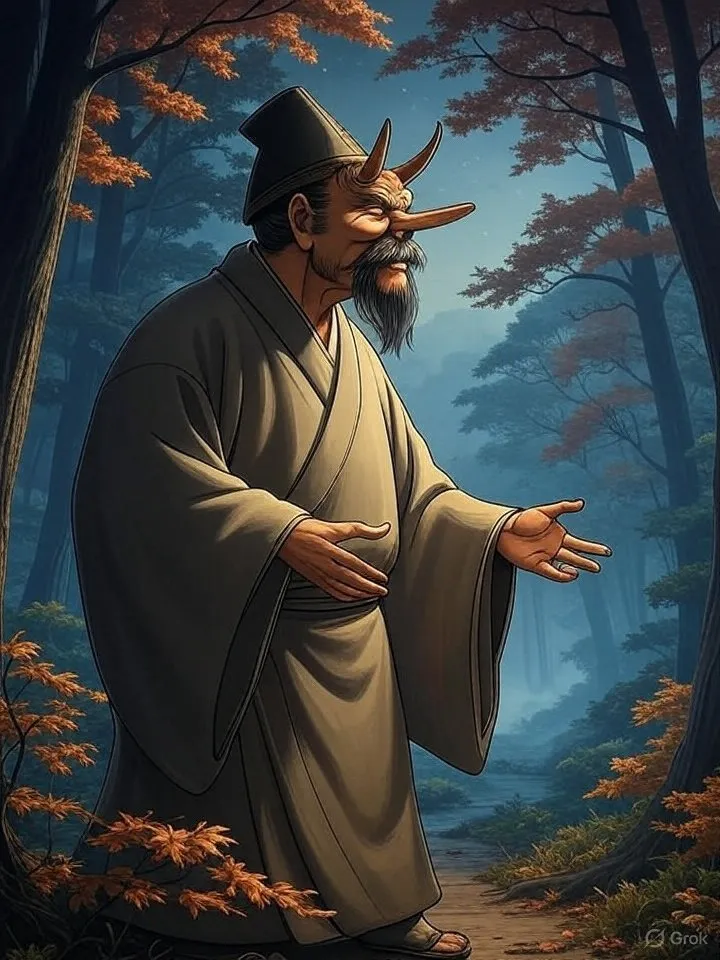
Illustrated folktale
The tale of Sōjōbō

Deep in the heart of Mount Kurama, where mist veiled the peaks and ancient cedar trees whispered secrets to the wind, there dwelled Sōjōbō, the venerable leader of the tengu. His abode was hidden from mortal eyes, yet his wisdom and power resonated throughout the land like a gentle breeze that rustled the leaves.
It was said that in bygone days, when the sun dipped into the horizon and painted the sky with hues of crimson and gold, Sōjōbō would emerge from his sanctuary to stroll through the mountainside. His long white beard flowed behind him like a river of silk, while his daitengu features seemed almost benevolent as he smiled upon the world.
One autumn evening, a young ascetic named Kaito ventured onto Mount Kurama in search of enlightenment. For years, he had wandered the countryside, studying under various masters and seeking to understand the mysteries of life. Yet, as he climbed higher into the mountains, his heart remained unfulfilled.
As night began to fall, casting the mountain in a deep twilight, Kaito stumbled upon an ancient grove where the trees seemed to hum with an otherworldly energy. He sensed that this was no ordinary place and hesitated to approach. Suddenly, a rustling in the underbrush announced Sōjōbō's presence.
The tengu leader emerged from the shadows, his fan of feathers waving gently as he regarded Kaito. His eyes, like lanterns in the dark, sparkled with an unyielding intensity that both frightened and fascinated the young ascetic. "Why have you come to this place, little one?" Sōjōbō asked, his voice as calm as a still pond.
Kaito explained his quest for enlightenment, sharing tales of his studies and travels. The tengu listened intently, his face aglow with an inner light that seemed almost divine. When the young ascetic finished speaking, Sōjōbō nodded thoughtfully and beckoned him to follow.
Through a winding path, Sōjōbō led Kaito deeper into the mountainside. They walked beneath towering trees whose trunks seemed to reach for the stars, and the air was filled with an expectant silence that hung like a promise. Finally, they arrived at a secluded clearing where the moonlight bathed the surroundings in an ethereal glow.
In this tranquil setting, Sōjōbō began to teach Kaito the ancient ways of the tengu – the art of harnessing wind and water, the discipline of spirit and flesh. As the young ascetic learned, his heart and mind opened like a lotus flower blooming in the moonlight. The secrets that Sōjōbō imparted were not mere teachings but living essences, infused with the wisdom of the ages.
And so Kaito spent many moons on Mount Kurama, studying beneath the guidance of the revered tengu leader. When his studies concluded, he descended from the mountain a transformed individual, carrying within him the essence of Sōjōbō's teachings and radiating an aura of serenity that commanded respect.
Though years passed, whispers of Kaito's enlightenment reached the ears of Sōjōbō, who smiled knowingly in his hidden sanctuary. For he understood that true mastery was not solely a product of study or power but also of the depths to which one could listen – and respond with an open heart.