

Name Meaning
Overview
Shishi (獅子) is the Japanese term for lion, commonly used to refer to the traditional guardian statues found at temple gates.
- Shishi = Lion (獅子)
Origin
- Introduced from China and Korea through Buddhist and Shinto traditions.
- Eventually evolved into distinct lion-dog forms in Japanese art and temple architecture.
Appearance
- Usually appear in pairs: one with an open mouth (“A”) and one with a closed mouth (“Un”).
- Stylized, muscular bodies with fierce expressions.
- Some may have a horn or be depicted with a ball or cub.
Behavior & Myths
- Stand guard at temple or shrine entrances to ward off evil spirits.
- Considered sacred protectors and part of temple ritual symbolism.
- Believed to balance spiritual forces—destruction and creation.
Symbolism
- Represent courage, protection, and divine guardianship.
- The “A-Un” posture symbolizes the beginning and end of all things.
- Often confused with Komainu, which serve similar roles in Shinto contexts.

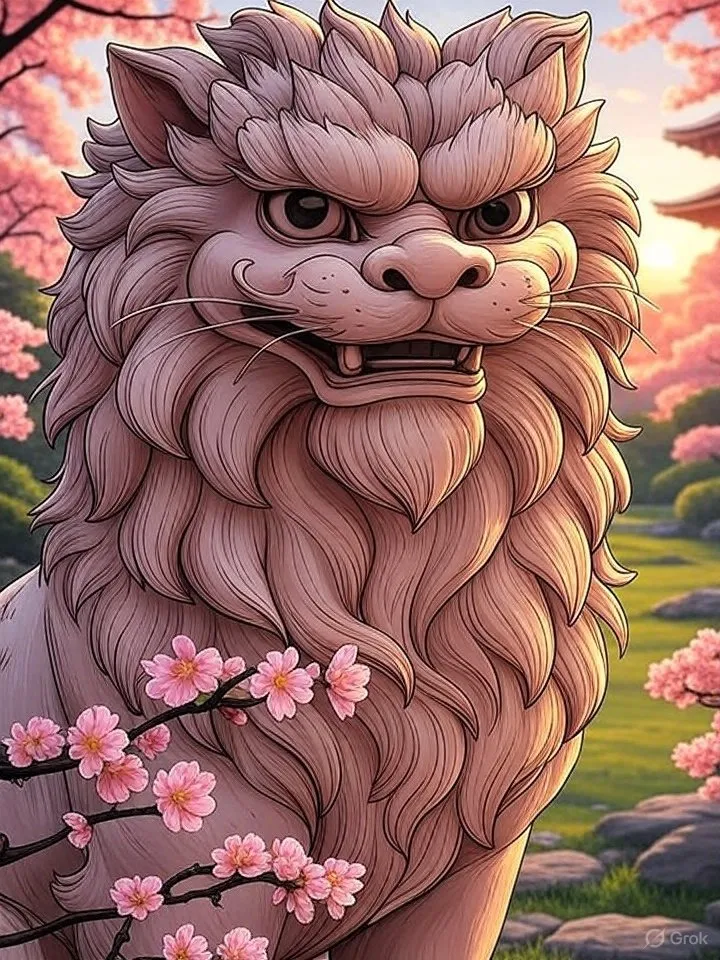
Illustrated folktale
The tale of Shishi

In the stillness of dawn, when the misty veil that shrouded the temple grounds began to lift, two Shishi stood vigilant at the entrance. Their eyes, like lanterns in the dark, burned with an inner fire, watching over the sacred precincts.
The open-mouthed one, Ahn, was said to embody the fierce energies of creation, while his counterpart, Un, with mouth closed in a serene line, represented destruction's balance. Together they stood as sentinels, guarding against malevolent spirits that sought to desecrate the temple's peace.
One day, a young monk named Kaito wandered into the garden, searching for rare herbs for the abbot's sake. As he delved deeper into the underbrush, his footsteps awakened the slumbering earth. The Shishi, attuned to every tremor and rustle, immediately sensed the disturbance.
Ahn's eyes flashed brighter, like sparks striking flint, while Un's gaze remained tranquil, yet unyielding. They parted, allowing Kaito to pass between them, but their vigilance never wavered. As he reached for a rare species of sage, Ahn let out a low rumble, causing the young monk to freeze.
Un stepped forward, his closed mouth seeming to hold its breath in anticipation. With an almost imperceptible nod, Kaito understood the Shishi's unspoken warning: beware the darkness that lurked within himself. The monk looked inward, recognizing the seeds of doubt and fear he had been sowing, like weeds in a fertile garden.
Moved by this newfound awareness, Kaito returned to the temple with humility in his heart. He spent many moons tending the gardens, nurturing both body and spirit. Ahn and Un watched over him, ever present yet unseen, as he cultivated compassion and understanding.
Their roles became intertwined: Ahn's fiery energy tempered by Un's stillness, while Kaito's own spirit balanced between the two poles. As he tended the gardens, the Shishi stood guard at every step, silently acknowledging the young monk's growth.
One moonlit eve, as Kaito gazed upon the tranquil grounds, now teeming with life, the Shishi vanished from their stations. In their place stood a pair of identical cubs, frolicking beneath the same watchful gaze that had once guarded the entrance. Ahn and Un, having fulfilled their duty to protect and nurture, had passed on their sacred charge to the next generation.
Their passing was marked by an extraordinary phenomenon: for one fleeting night, the moon's rays broke through the clouds, illuminating the temple grounds in a brilliant glow. The cubs, now guardians-in-training, watched with wide eyes as Ahn and Un's essence merged into the very fabric of the garden. In that instant, Kaito understood the full depth of their roles: not just protectors, but catalysts for balance and harmony.
As dawn broke over the temple grounds, the Shishi cubs stood poised at the entrance, eager to take up their duties. Ahn's fiery spirit now a part of the earth itself, while Un's tranquility infused every breath of air. Their legacy remained: the living embodiment of creation and destruction, ever entwined in a cycle of renewal, as the temple grounds continued to flourish under Kaito's care.