
Name Meaning
Overview
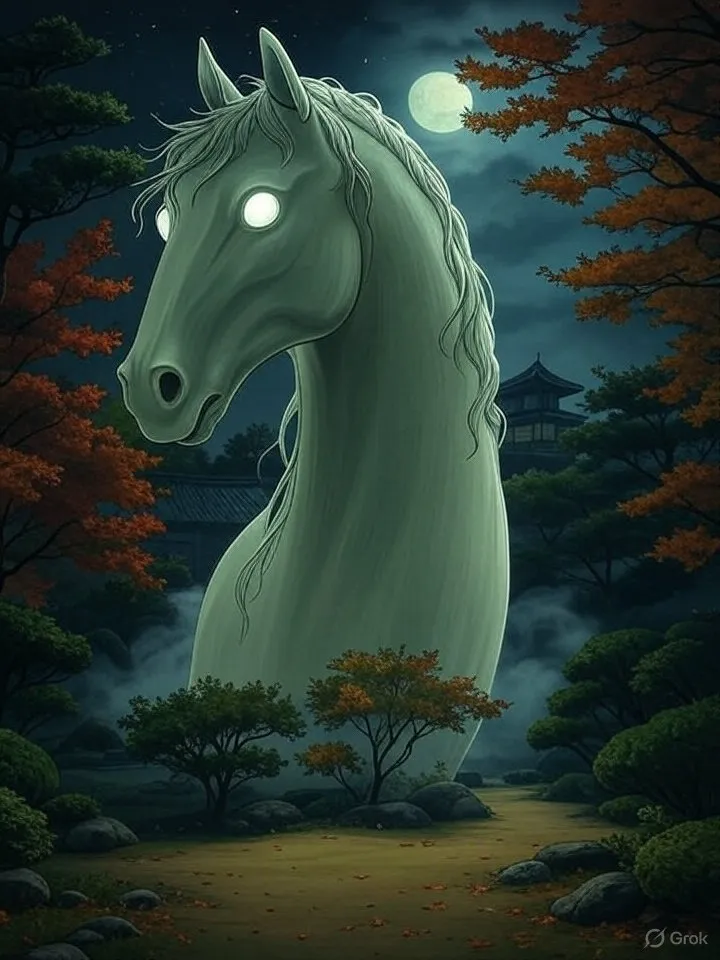
Sagari (さがり) literally means “to hang” or “dangling,” referring to the way the ghostly horse head hangs from trees.
Origin
- Originates from the folklore of Kyūshū, Japan's southernmost main island.
- Thought to be the restless spirit of a horse that died in distress or was sacrificed.
Appearance
- A disembodied horse’s head with wide, staring eyes and an open mouth.
- Hangs from tree branches, swaying as if alive.
- Appears suddenly on forest roads or mountain paths at night.
Behavior & Myths
- Let out terrifying neighs that echo through the woods.
- Believed to bring illness or misfortune to those who encounter it.
- Encounters are considered omens of disaster.
Symbolism
- Represents lingering grief and pain from violent or sorrowful deaths.
- Serves as a spiritual warning not to ignore the suffering of animals.

Illustrated folktale
The tale of Sagari

In the depths of Kyūshū's forests, where the moonlight filtering through the trees painted dappled shadows on the ground, there lived an old horse named Kaito. He was a majestic creature, with a coat as black as the night sky and a spirit that seemed to rival the stars in their fierce beauty.
For years, Kaito had carried his master, a kind old farmer, through the mountain paths and forest roads, never faltering in his duty or showing signs of weariness. But one fateful day, disaster struck. A band of hunters, driven by greed and a desire for power, chased Kaito down with cruel intent.
Cornered and terrified, Kaito's heart pounded within his chest like a drumbeat as he fought valiantly to protect himself and his master from the merciless hunters. Alas, fate was not on their side. As the sun dipped below the horizon, casting the forest in an eerie twilight, Kaito lay dying, his vision fading into darkness.
His spirit lingered, however, trapped between worlds by the anguish of his death. The farmers and woodcutters who had known him whispered that Kaito's restless energy would one day manifest as a terrifying omen – a harbinger of misfortune and illness to those who crossed its path.
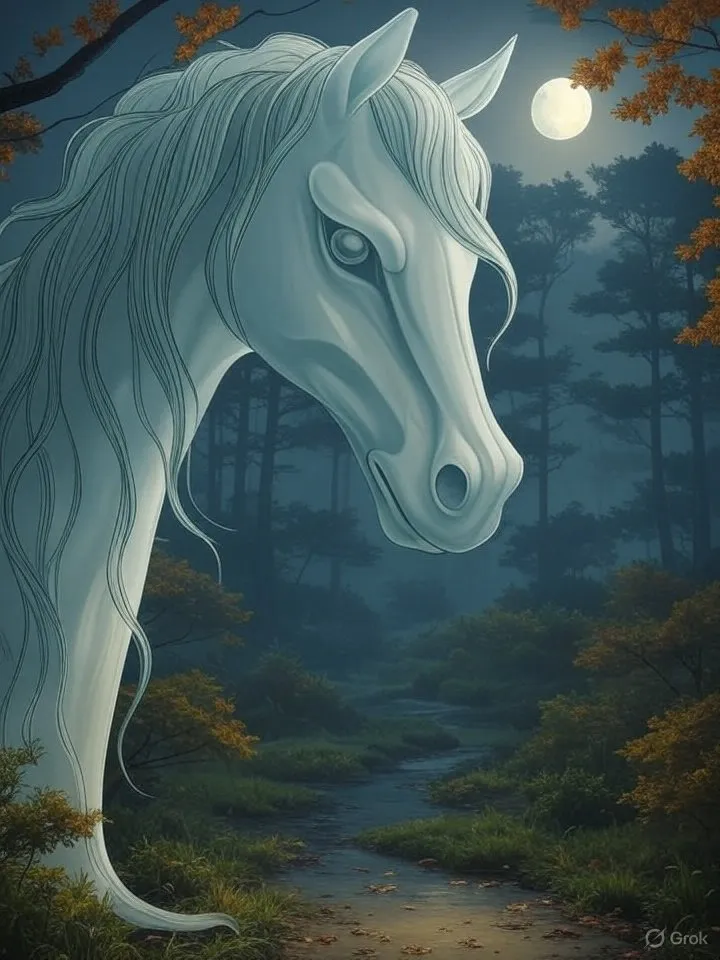
And so it was said, on moonless nights, when the wind rustled through the trees like an old man's sighs, the disembodied head of a horse with wide, staring eyes and an open mouth would appear, suspended from the branches of ancient trees. Its long neck twisted in agony, as if still trying to shake off the cruel weight that had brought Kaito down.
As travelers passed through the forest, they would hear the terrible neighing that seemed to come from nowhere and everywhere at once – a chilling cry that sent shivers down their spines and made their hearts tremble within their chests. It was said that on those nights, when the Sagari's haunting cries echoed through the woods, it was not just an animal's spirit that howled in sorrow, but also the collective grief of all creatures who had met a violent or untimely end.
A young farmer named Taro once claimed to have seen the Sagari while wandering the forest at midnight. He said that as he stood frozen with fear, transfixed by the creature's staring eyes, Kaito's ghostly head leaned in close and whispered a single word: "Kizuna" – bond or connection.
Taro never forgot those words, nor did he ever forget the terror that gripped his heart when faced with the Sagari. He learned to live in harmony with nature, respecting the suffering of all creatures and ensuring their well-being before reaping any benefit from them. And though he never saw the Sagari again, its haunting presence lingered within him, a constant reminder of the delicate balance between life and death.
Some say that on quiet nights, when the wind stirs through the trees just so, you can still hear Kaito's mournful cries echoing through the forest – a melancholy reminder to cherish every creature's bond with the world around them.