
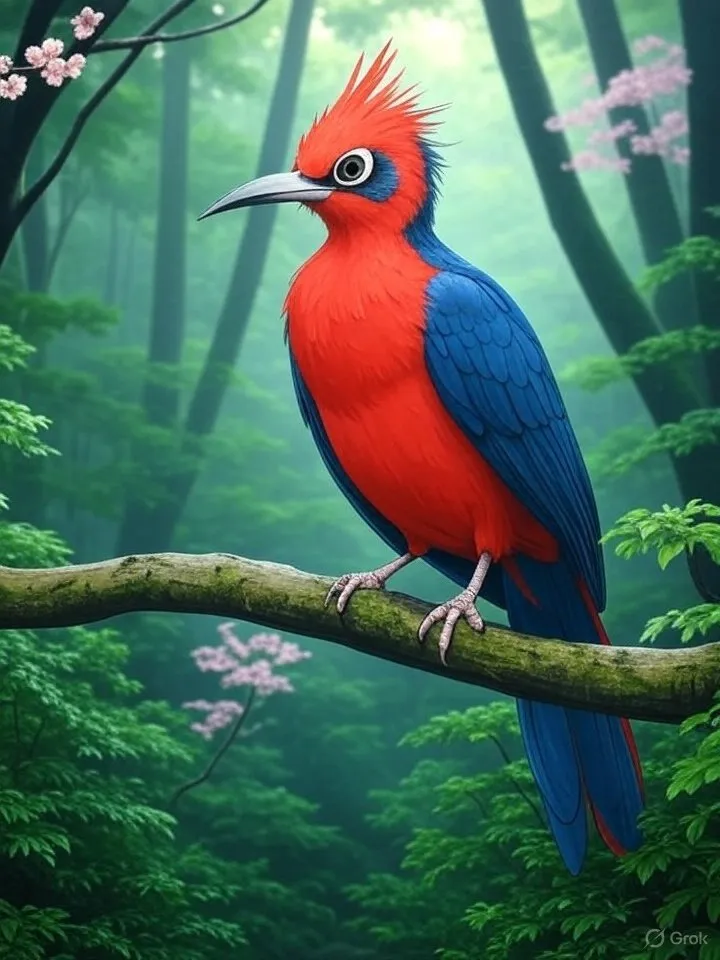
Name Meaning
Konoha-tengu (木の葉天狗) means "leaf tengu" or "tengu of the leaves." These beings are a subtype of tengu associated with forests and foliage.
- Konoha (木の葉) = leaf
- Tengu (天狗) = a class of supernatural creatures often depicted with avian or long-nosed human features
Origin
- Rooted in ancient Japanese mountain and forest lore.
- Thought to be lesser tengu in the hierarchy of these supernatural beings.
- Legends suggest they patrol woodland areas and watch over travelers.
Appearance
- Often depicted with a bird-like face and feathered body.
- May carry fans made of leaves or feathers.
- Smaller and more animalistic than Daitengu (major tengu).
Behavior & Myths
- Known for playing tricks on humans, especially arrogant monks or travelers.
- Can be protective or wrathful depending on human behavior.
- Associated with the rustling of leaves and sudden gusts in forests.
Symbolism
- Represents the untamed spirit of nature and its watchers.
- Symbolizes balance between playfulness and danger in forest folklore.
- May serve as forest guardians in some regions.


Illustrated folktale
The tale of Konoha-tengu

Deep within the heart of Amanohashidate's ancient forest, where the whispering leaves and soft rustling of branches seemed to carry secrets on the wind, there lived a Konoha-tengu named Kaito. He was a guardian of sorts, tasked with watching over travelers who dared to venture into this sacred realm.
Kaito's home was a tangle of vines and twisted trunks, hidden away from prying eyes. His form blended seamlessly with the shadows: a bird-like face perched upon his neck, feathers ruffled by the gentle caress of forest breezes. He moved unseen, a whisper in the underbrush.
One autumn eve, as sunset painted the sky with hues of crimson and gold, two travelers chanced upon the forest's edge. A young monk named Kenji had been walking for days, driven by a zeal to reach the distant temple of Mount Hiei. Beside him walked his traveling companion, a wise woman named Akane, who carried an air of quiet authority.
As they entered the forest, the rustling of leaves beneath their feet alerted Kaito to their presence. He regarded them with curiosity: the monk's fervor seemed almost... amusing. The tengu's heart stirred within him – it had been a while since he'd indulged in the simple pleasure of mischief.
Kaito flitted ahead, carrying on his shoulder a delicate fan fashioned from leaves and feathers. Its gentle flutter created an eerie whisper among the trees. Kenji, caught up in his own reflections, failed to notice the rustling growing more insistent, as if unseen spirits danced around him. Akane, however, sensed something amiss.
As night began to settle over Amanohashidate, Kaito led the travelers deeper into the forest, creating a whirlwind of autumn leaves in his wake. The pair stumbled through the swirling tempest, disoriented by the sudden gusts that stung their faces like whispers from the tengu's fingers.
Akane recognized the warning signs: Kaito's tricks were not born of malice but of a desire to test their resolve and humility. She nodded to Kenji, urging him forward with an almost imperceptible gesture. Together they walked through the tempest, unphased by the whirling leaves that obscured their path.
Kaito watched from the shadows as the pair continued on their journey. He was pleased – for a moment, at least – by their willingness to adapt and listen to the whispers of the forest. Though Kenji's zeal had not entirely dissipated, his stride became more measured, acknowledging the subtle balance between determination and respect for the land.
As the travelers vanished into the darkness, Kaito settled back into his hiding place among the roots. The wind died down, leaving behind an expectant hush. In the silence, he reflected on their brief encounter: Kenji had not been repelled by the forest's secrets or dismissed its whispers as mere tricks.
In that moment, the Konoha-tengu realized a truth – not all humans were as arrogant as those his kind often encountered. There existed a balance within them, one that acknowledged both the playfulness and the dangers of the untamed spirit that dwelled in Amanohashidate's heart.
Kaito vanished into the darkness, leaving behind only the faint scent of rustling leaves on the autumn breeze.