
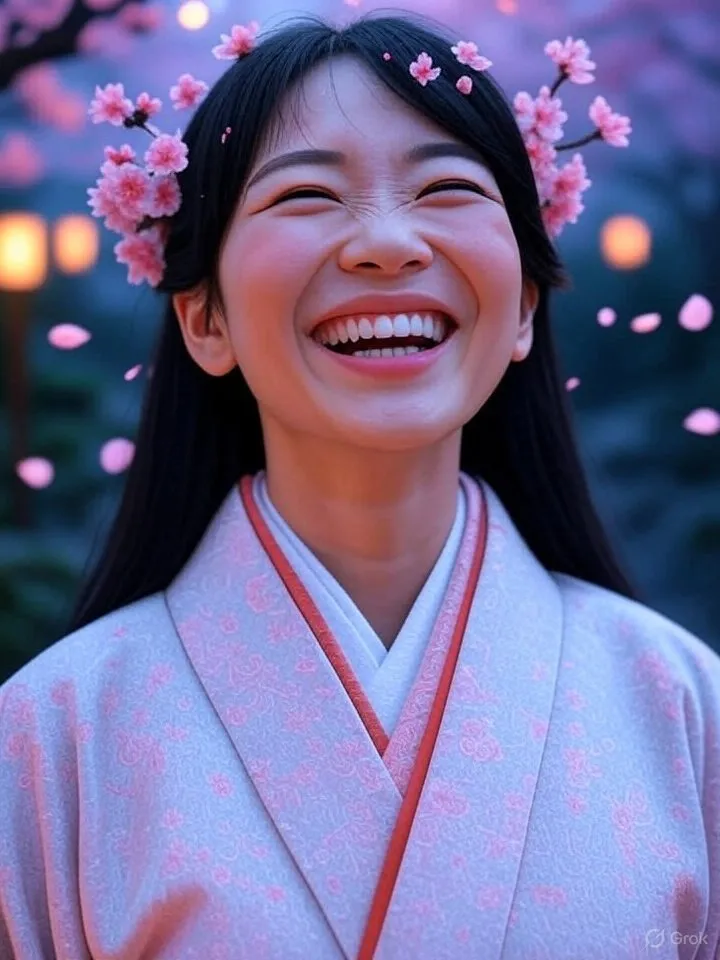
Name Meaning
Overview
Kerakera-onna (けらけら女) literally translates to "cackling woman" in Japanese. The word "kerakera" mimics the sound of high-pitched laughter.
Origin
- Appears in obscure folk legends from various rural regions in Japan.
- Often linked to mysterious and frightening phenomena in the night sky.
Appearance
- Described as a giant female figure looming in the clouds or high above the ground.
- Always laughing loudly, with wild hair and exaggerated facial expressions.
Behavior & Myths
- Appears unexpectedly, causing unease and fright among villagers and travelers.
- Her cackling is believed to bring bad luck, especially to those who hear it clearly.
- Some stories say that witnessing her is a harbinger of strange events or misfortune.
Symbolism
- Symbolizes eerie laughter, madness, and fear of the unknown above.
- May reflect the fear of being mocked or haunted by unseen powers.


Illustrated folktale
The tale of Kerakera-onna

In the depths of winter, when the nights were longest and the moon hung low in the sky, the villagers of Akakawa would huddle together, whispering tales of Kerakera-onna's appearances. Some said she was a harbinger of great storms, while others claimed to have seen her laughing as their homes burned to ashes.
I, Kenji, lived in those days, a young traveler with a heart full of wonder and a soul afraid of the unknown. My journey had brought me to Akakawa, seeking refuge from the harsh winds that howled across the mountains like wolves. As I settled into the local inn, the proprietor, old Manabu, leaned in close and whispered: "Beware Kerakera-onna's cackle, Kenji. It means no good."
That night, as the wind died down, a strange stillness fell over the village. I stepped out onto the veranda, wrapped in my cloak, and gazed up at the star-studded sky. A faint glow began to spread across the horizon, like lanterns carried by an unseen procession. Amidst this ethereal light, I spotted her: Kerakera-onna.
Her form was colossal, looming above the trees as if conjured from the very clouds themselves. Wild hair wracked her face, and her features twisted in a mirthless grin. Her laughter boomed through the night, like thunder shattering a thousand delicate vases. The sound sent shivers coursing down my spine.
As I watched, transfixed by fear, she began to walk toward me, her footsteps echoing across the hills. Manabu's words echoed in my mind: "No good." I felt my breath catch as her gaze fixed upon me, and for an instant, our eyes locked in a silent understanding.
She halted at the edge of the village, her laughter subsiding into a low hum, like a distant engine growling to life. In that stillness, a strange thought occurred to me: Kerakera-onna was not mocking us, nor predicting doom – she was warning us away from some hidden truth, veiled by darkness and shadow.
As I stood frozen, the wind picked up once more, carrying with it whispers of an ancient language I couldn't quite decipher. Kerakera-onna vanished as suddenly as a candle snuffed out in the breeze. The moon reappeared, full and serene, casting its gentle light upon the village below.
Though I never forgot that night, I realized Manabu's words were not simply warnings but attempts to shield us from some unknown, unnamable power lurking beyond our comprehension. Kerakera-onna was a guardian, perhaps, or an echo of our own deepest fears – a reminder that in the depths of darkness lies a mystery waiting to be unraveled.
As I continued my journey, I carried with me the memory of her cackle and the eerie laughter it had unleashed within me. Though I never looked upon Kerakera-onna again, I sensed her presence in every wind-borne whisper and moonlit shadow that followed me through the world's vast expanse.