
Name Meaning
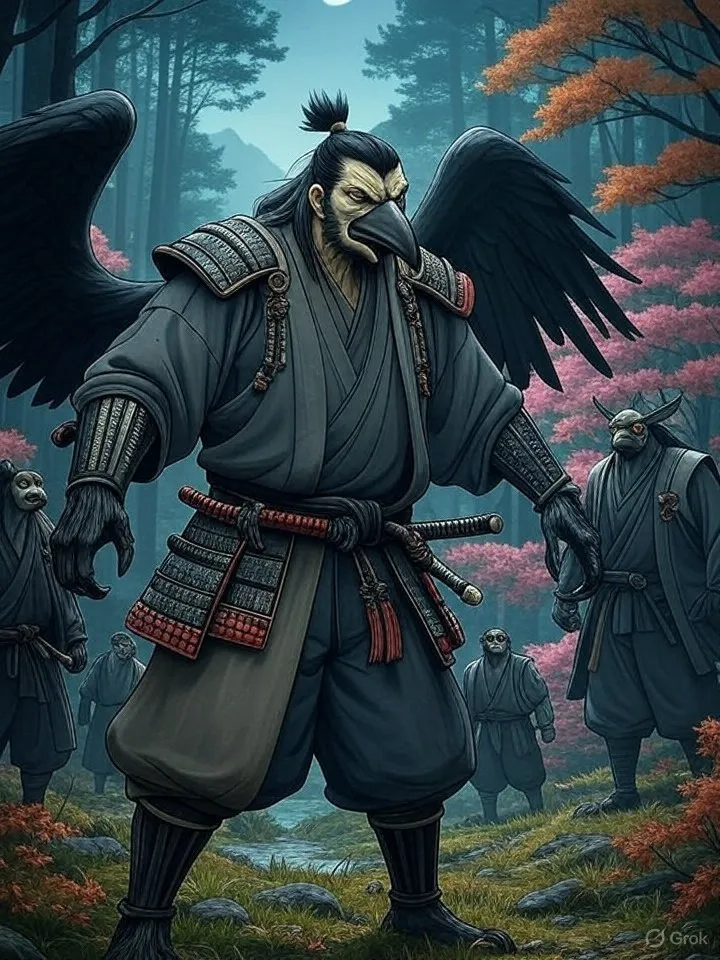
Karasu-tengu (烏天狗) literally means "crow tengu" and is a subclass of the tengu yokai. It is often depicted with the body of a man and the head or beak of a crow.
- Karasu (烏) = crow
- Tengu (天狗) = heavenly dog (generic tengu class)
Origin
- Originates in the mountainous regions of Japan where it is seen as a protector and a punisher of arrogance.
- Linked to the broader tengu mythology, which includes both long-nosed and bird-headed types.
Appearance
- Humanoid body with wings and a crow-like head or beak.
- Usually carries a fan made of feathers or leaves, and sometimes a sword or staff.
- Often depicted wearing Yamabushi (mountain priest) garb.
Behavior & Myths
- Known to abduct or punish prideful monks and warriors.
- Also serves as protectors of sacred mountains and skilled in martial arts.
- Can teach humans secret techniques if respected.
Symbolism
- Embodies the balance of wisdom and aggression.
- Seen as both a destructive force and a wise guardian.
- Appears in various Shinto and Buddhist mountain practices.

Illustrated folktale
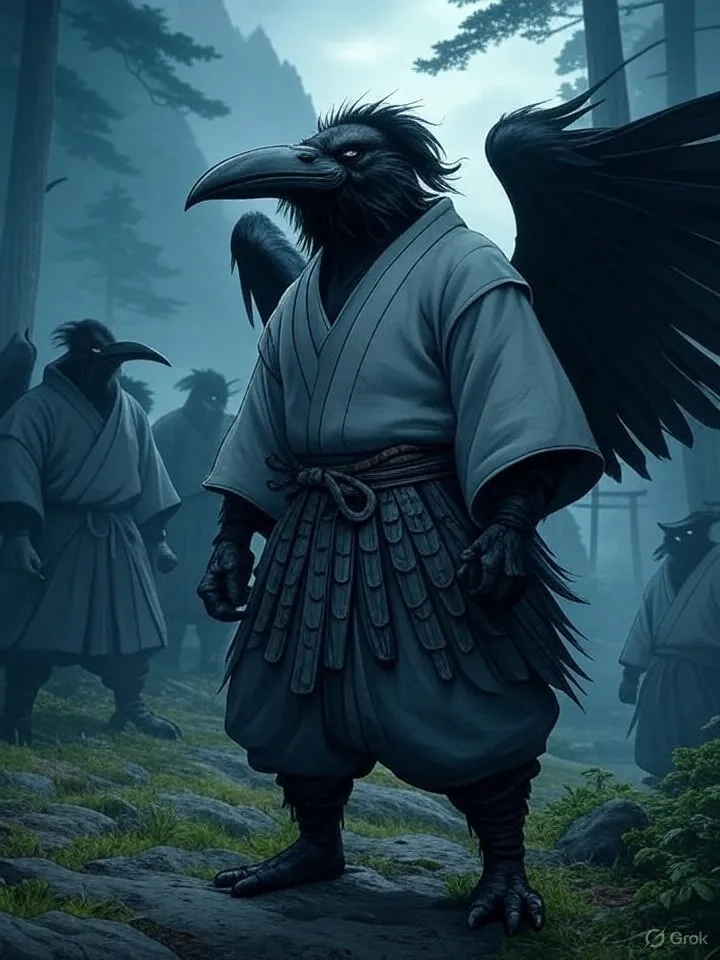
The tale of Karasu-tengu

In the mist-shrouded mountains of Akakawa, where the air is sweet with the scent of cherry blossoms and the sound of wind whispers secrets to the trees, there lived a young Yamabushi named Kaito. He was a proud warrior-monk, skilled in the art of combat and possessed of an unyielding spirit.
Kaito's prowess had not gone unnoticed, for he was often called upon by villagers to vanquish bandits that terrorized their roads. Yet, as his fame grew, so did his arrogance. He began to think himself invincible, a divine warrior chosen by the gods themselves to rule over the mountains.
One fateful evening, as Kaito climbed a treacherous path to meditate on a windswept peak, he heard the rustling of wings and the soft whispering of leaves. A gentle breeze carried the scent of wet earth and damp stone, and Kaito's heart stirred with unease.
He beheld a towering figure cloaked in mist, its eyes blazing like embers from a dying fire. The air was heavy with an otherworldly presence, and Kaito knew himself face to face with the Karasu-tengu, the guardian of Akakawa's sacred mountains.
"You have been chosen, Kaito," the tengu declared in a voice that shook the trees, "to receive a lesson from one who has walked the paths of both wisdom and fury. You would do well to listen, for your pride threatens to consume you like a raging storm."
With these words, the Karasu-tengu unfurled its fan, adorned with feathers that shimmered in hues of indigo and crimson. The wind died down, and an expectant silence fell upon the mountain.
Kaito approached, humbled by the weight of the tengu's gaze. "Speak your lesson," he entreated.
"Your power lies not in strength or valor alone," the Karasu-tengu explained, its beak-like mouth twisting into a wry smile. "It is balance that gives true might: the harmony between aggression and wisdom, as delicate as a winter snowflake and as enduring as an ancient tree."
As if by magic, the mist parted to reveal a hidden glade. The Karasu-tengu led Kaito to its center, where a magnificent stone stood shrouded in a canopy of leaves.
"This is the Heartstone of Akakawa," the tengu revealed, "a symbol of our sacred balance. You have been chosen to receive its secret: that strength and gentleness coexist within each warrior-monk, waiting to be awakened by respect and humility."
Under the Karasu-tengu's guidance, Kaito comprehended the ancient wisdom and understood the futility of his arrogance. The lesson taken, he descended from the peak with a new heart, armed not only with sword and fan but also with the balance that would forever change him.
As Kaito vanished into the valley below, the Karasu-tengu watched over the mountains, a guardian vigilant against those who would let pride consume their spirit.