
Name Meaning
Overview
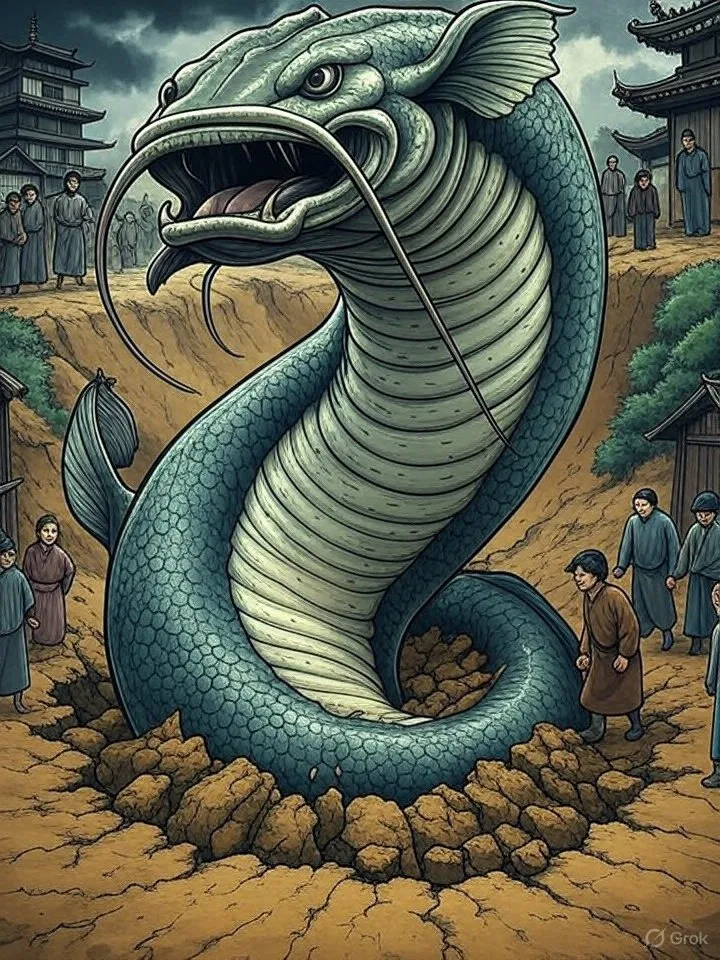
Jishin-namazu (地震鯰) combines "jishin" (earthquake) and "namazu" (catfish), reflecting the belief that this creature causes seismic tremors.
- Jishin (地震) = earthquake
- Namazu (鯰) = catfish
Origin
- One of the most iconic disaster-related yokai in Japanese mythology.
- Gained prominence during the Edo period and the 1855 Ansei Edo earthquake.
- Associated with Namazu-e woodblock prints used to convey social or political messages.
Appearance
- A colossal black or brown catfish with trembling whiskers.
- Sometimes bound or guarded by a deity, such as Kashima.
- Its stirring beneath the land is believed to shift tectonic plates.

Behavior & Myths
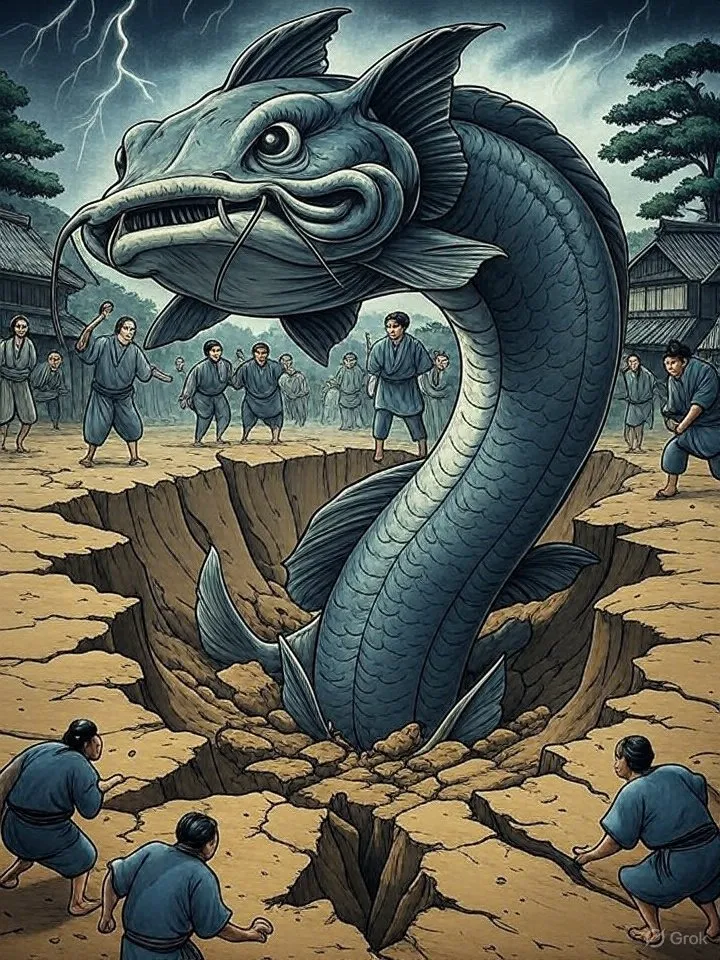
- When it thrashes its tail underground, earthquakes follow.
- Said to live under the islands of Japan.
- Occasionally restrained by the god Kashima with a magical stone or sword.
Symbolism
- Represents nature’s wrath and the unpredictability of earthquakes.
- Used in art to express human vulnerability and divine punishment or balance.
- Reflects Japan’s deep cultural engagement with natural disasters.
Illustrated folktale
The tale of Jishin-namazu

In the depths of the Inland Sea, where the sunlight barely reaches, the Jishin-namazu stirred its massive body. The earth trembled as it swished its tail, sending ripples through the darkness. The sea gods whispered warnings to those on land: "The fish stirs, the earthquake approaches."
A humble rice farmer, Kaito, lived in a small village on the coast. He had always been attuned to the rhythms of nature, listening for the subtle signs that foretold the changing seasons. But even he was not prepared for the day the Jishin-namazu's agitation reached new heights.
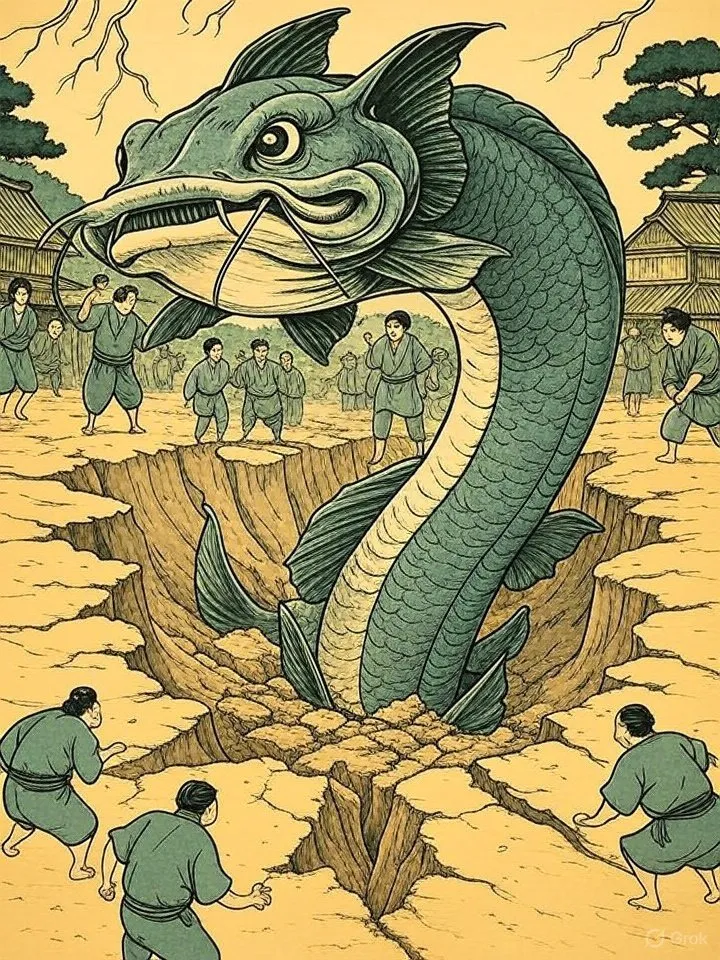
As Kaito worked in his fields, the ground beneath him began to shudder. The earth cracked and groaned like an ancient gate creaking open. He stumbled, his foot slipping on the uneven soil. The sky darkened, as if a shadow had descended upon the land.
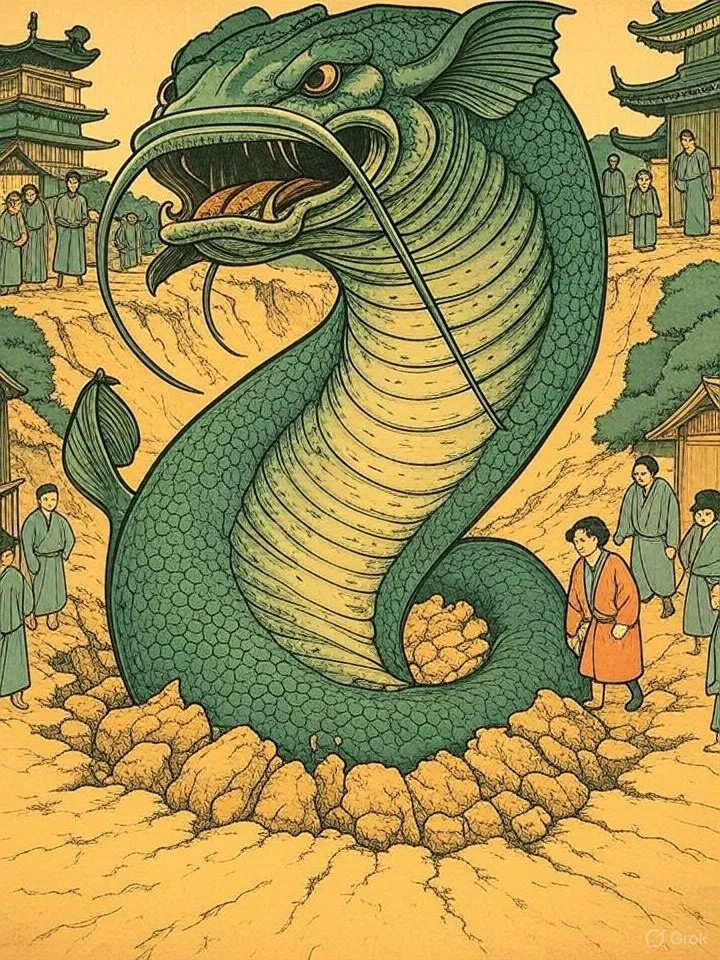
In the distance, the sound of drums echoed through the valleys. It was the village priest, Taro, calling out to the gods for protection and peace. But Kaito knew that the Jishin-namazu's fury could not be tamed so easily. He saw it then – a colossal shape beneath the waves, its scales glinting like dark jewels.
The fish rose higher, its eyes blazing with an inner fire. The villagers fled in panic as the earthquake intensified. Kaito watched, frozen, as the Jishin-namazu thrashed its tail, sending shockwaves through the land.
In the chaos that followed, Taro was seen standing at the edge of the village, his hands clasped together in prayer. His eyes were closed, but a faint smile played on his lips. As the earthquake raged on, he whispered an ancient incantation: "Kashima-sama, gentle one, calm the fish's fury."
The Jishin-namazu continued to writhe and twist, its power coursing through the earth like a tempest. But Kaito sensed a subtle change in the air – as if the deity Kashima had indeed taken hold of the fish, restraining it with an invisible thread.
Slowly, the tremors subsided. The villagers emerged from their hiding places, surveying the damage to their homes and fields. Taro opened his eyes, which shone with a deep understanding. "The Jishin-namazu stirs," he said softly, "but Kashima-sama holds it in balance."
Kaito looked out at the Inland Sea, where the waves still churned from the fish's disturbance. He realized that even the earth itself was a realm of fragile equilibrium – where the gods and natural forces danced in an eternal ballet. The Jishin-namazu remained beneath the waves, its power simmering like a great furnace. But for now, the balance had been restored.