
Name Meaning
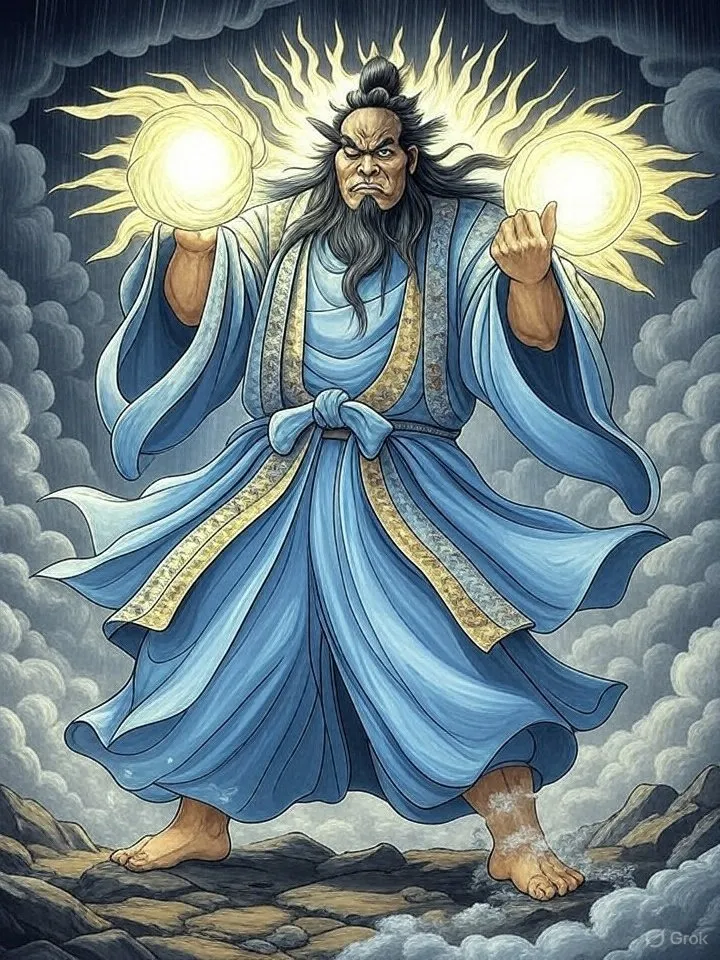
Ikazuchi-no-Kami (雷の神) translates directly to “God of Thunder.” The name derives from "ikazuchi" (thunder) and "kami" (deity or spirit).
Origin
- One of the oldest Shinto thunder deities, sometimes considered a form of Raijin.
- Mentioned in the Kojiki and Nihon Shoki, Japan’s earliest mythological texts.
- Also venerated as a protector of rice fields, bringing rainstorms.
Appearance
- Often depicted with drums that he strikes to create thunder.
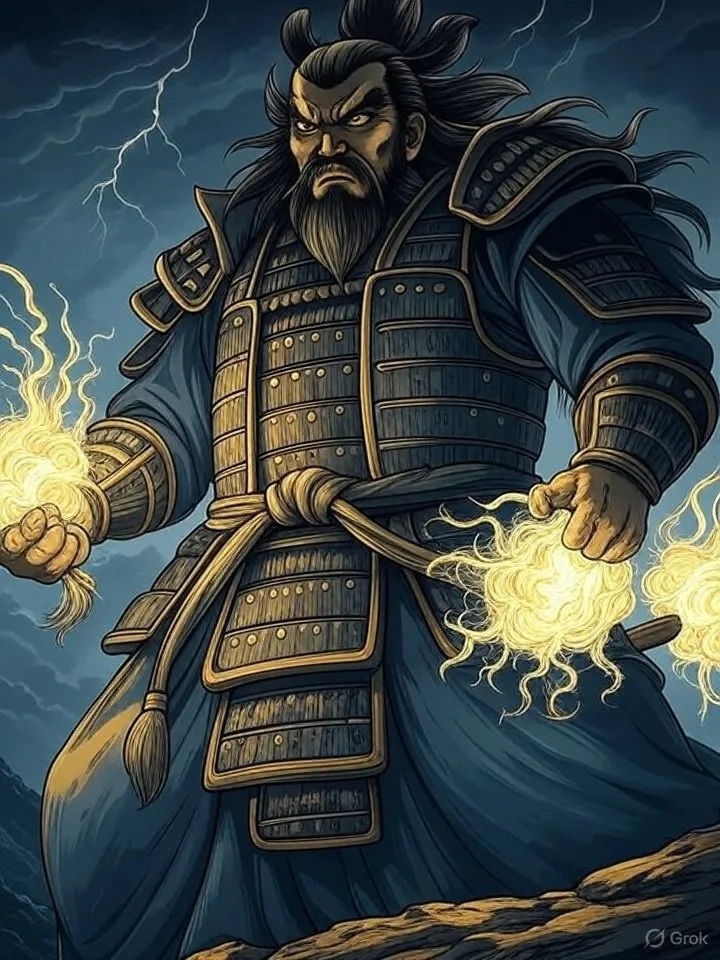
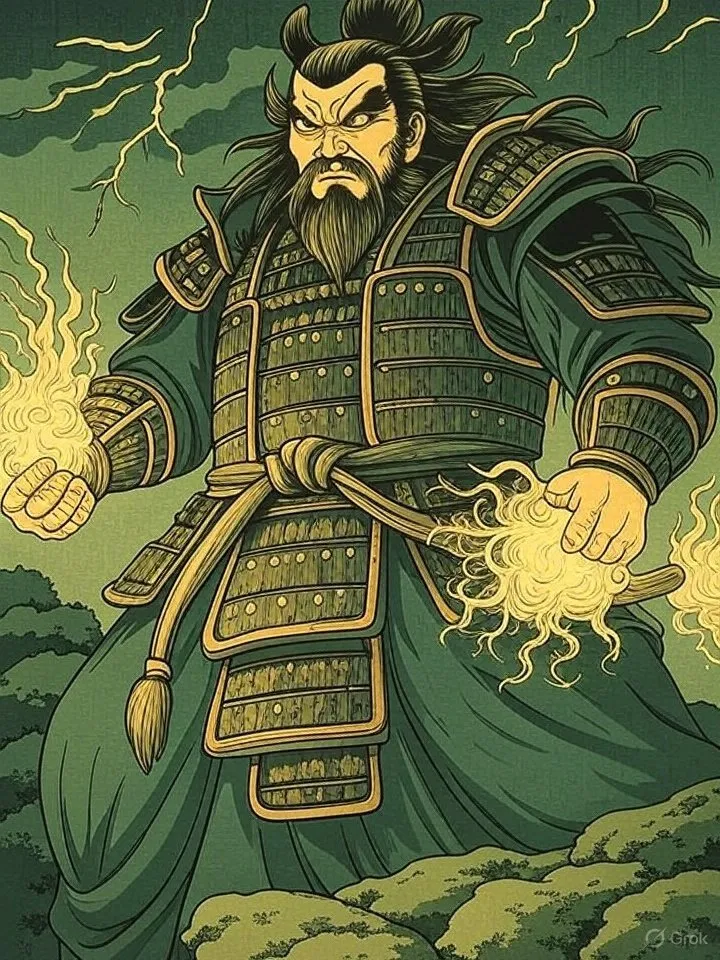
- Sometimes appears as a fierce man surrounded by lightning and clouds.
- May be represented in statues alongside Fūjin, the wind god.

Behavior & Myths
- Worshiped in shrines to protect from lightning strikes and drought.
- Considered both a punisher and bringer of blessings, depending on the season and context.
- Sometimes said to cause illness or spiritual disturbance if disrespected.
Symbolism
- Symbolizes divine power, natural force, and spiritual judgment.
- Represents the duality of nature — destructive yet life-giving.
- Invoked in agricultural rituals and festivals related to rain.
Illustrated folktale
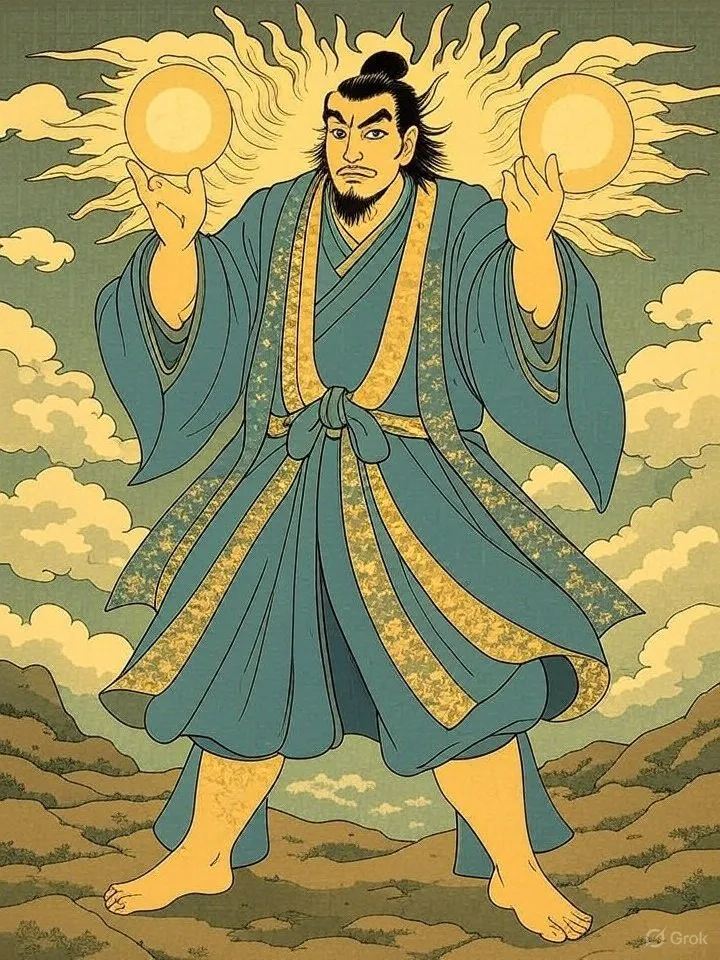
The tale of Ikazuchi-no-Kami

In the village of Akakawa, nestled between two great mountains, the farmers were beset by an unending drought. The rice fields lay parched and still, like the hearts of those who tilled them. Crops withered, livestock grew weak, and the people whispered among themselves of famine's dark shadow.
It was then that Kaito, a young farmer, decided to seek out the aid of Ikazuchi-no-Kami, the Thunder God. He had heard tales of the god's mighty drums, which could summon the storms and bring life-giving rains to the withered fields.
Kaito set out for the mountainous shrine dedicated to the Thunder God, carrying a gift of sake and a handmade drumstick. As he climbed higher, the air grew thick with electricity, and the trees seemed to tremble in anticipation. The villagers warned him of the god's fierce nature, but Kaito was resolute.
At the shrine, he found an elderly priestess, her eyes aglow like embers from a sacred fire. She welcomed Kaito and led him to the altar, where a majestic statue of Ikazuchi-no-Kami stood, drum at hand. The air was heavy with the scent of incense and the distant rumble of thunder.
As Kaito offered his gift and prayers, the wind began to pick up, rustling leaves and carrying whispers on its breath. Fūjin, the Wind God, appeared beside him, his robes billowing like a storm cloud. The two deities communed in hushed tones, their words lost amidst the growing tempest.
Suddenly, Ikazuchi-no-Kami raised his drum, and the mountain shook beneath Kaito's feet. A deafening crash of thunder boomed through the valley, and the sky darkened as if night itself had fallen. The wind howled in fury, whipping dust devils into existence. Water began to fall, at first a light drizzle but soon a torrential downpour that threatened to engulf the village.
Kaito watched in awe as the Thunder God summoned life-giving rains from the heavens. The drought-stricken fields drank deep of the waters, and green shoots burst forth from the earth like miracles. The villagers emerged, awestruck, to greet the new season's bounty.
Yet, even as the storms ceased and the sun broke through the clouds, a strange presence lingered in the air. Ikazuchi-no-Kami stood at the shrine, his drum still echoing with the reverberations of his call. A shadowy form hovered behind him, coalescing into a dark entity that seemed to draw sustenance from the god's power.
The Wind God Fūjin whispered to Kaito, "That is Karasu, the Raven, who feeds on the Thunder God's strength. His presence means balance must be maintained, lest the natural world succumb to chaos."
As the people rejoiced in their revived harvests, they knew that Ikazuchi-no-Kami watched over them still, his mighty drum ever prepared to summon life-giving storms and ward off the shadows of famine and despair.