
Name Meaning
Overview
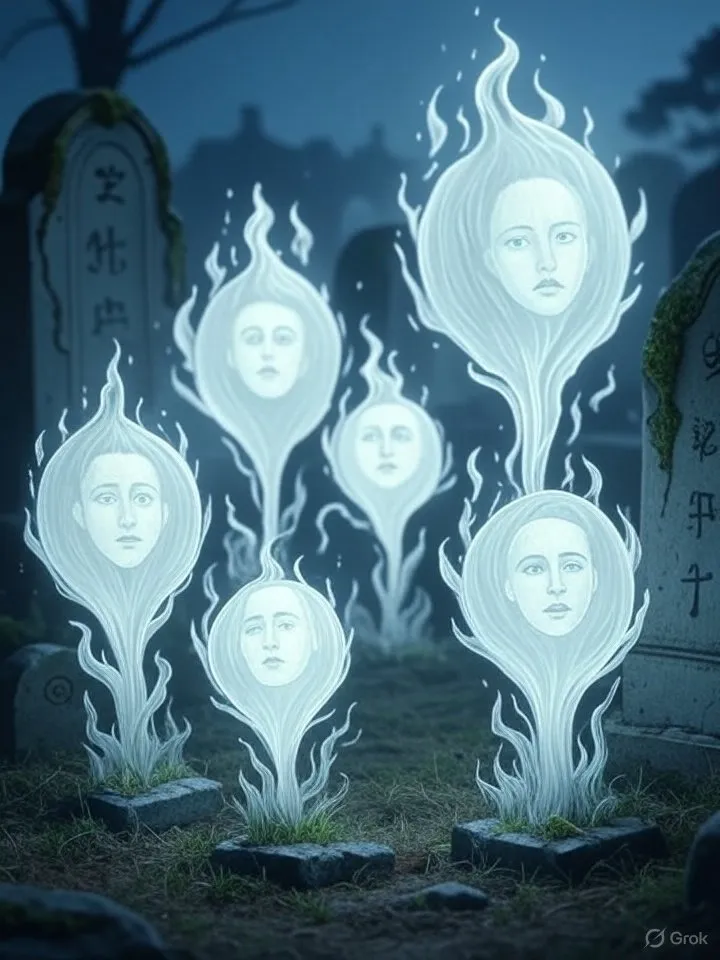
Hitodama (人魂) literally means "human soul." It refers to ghostly lights or fireballs seen floating through the night, believed to be the soul leaving a person's body after death.
- Hito (人) = person
- Dama (魂) = soul, spirit
Origin
- Seen in both Shinto and Buddhist folklore throughout Japan.
- Common in ghost stories and graveyard legends.
- Linked to the moment of death or nearby spiritual events.
Appearance
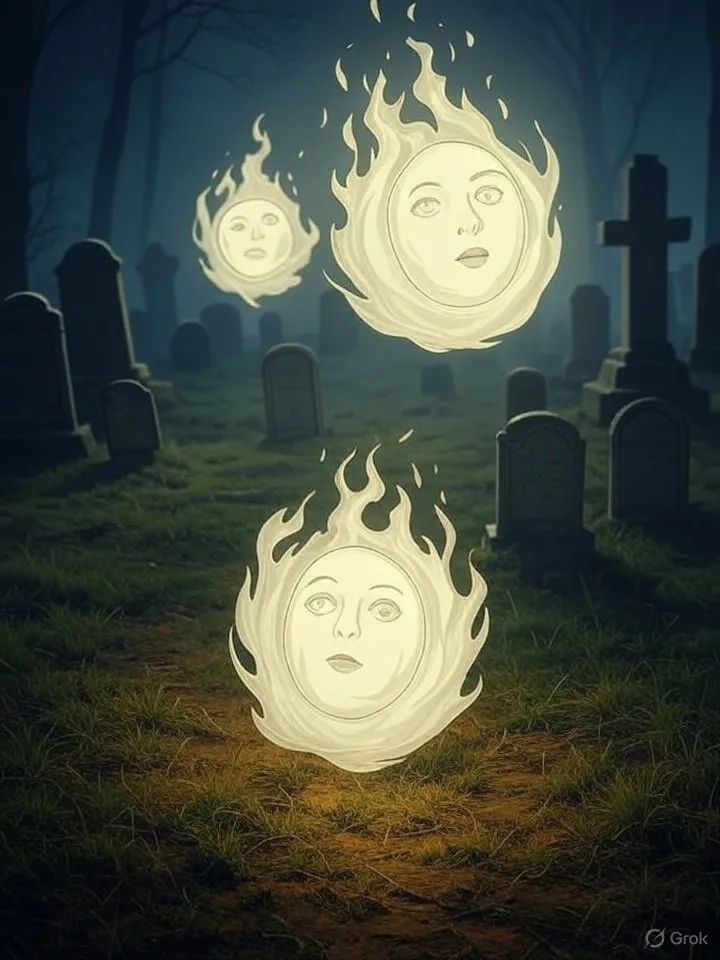
- Glowing blue, green, or white orb of flame.
- Often appears near temples, homes, or cemeteries at night.
- Sometimes trails a small tail of fire as it moves through the air.

Behavior & Myths
- Appears shortly before or after death to signify a soul departing.
- Can be seen by those with spiritual sensitivity or during rituals.
- Harmless, but witnessing one is considered a spiritual omen.
Symbolism
- Symbol of transition from life to death.
- Represents the fragile, luminous nature of the soul.
- Frequently depicted in horror and supernatural media.
Illustrated folktale
The tale of Hitodama

In the small village of Kamakura, where the misty dawn kissed the mountains, there lived an elderly woman named Kikuno. She was known throughout the village for her kindness and compassion, often visiting the sick and the elderly with gifts of warm rice porridge and stories of old.
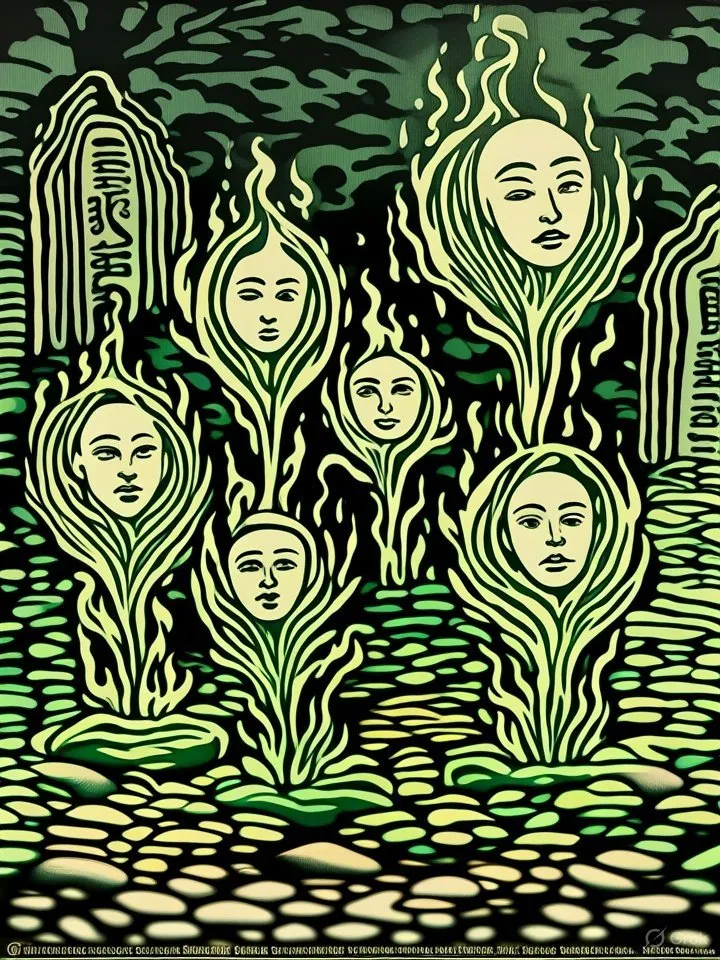
Kikuno's home stood near the edge of the graveyard, a place where families would come to honor their loved ones on special occasions. It was said that the Hitodama, those wispy spirits of the dead, roamed freely within the stone gates at night. Some claimed to have seen them trailing fire as they danced among the tombstones.
One autumn evening, as Kikuno prepared for her nightly rounds, she noticed an unusual silence in the air. The wind had died down, and the trees stood motionless, their leaves rustling softly against each other. As she wrapped a cloak around her shoulders, she felt a shiver run down her spine.
She set out into the graveyard, her wooden clogs echoing through the stillness. With every step, the air seemed to thicken, heavy with anticipation. The moon cast long shadows across the tombstones, making it seem as though the spirits of the dead were gathering around her. Kikuno lit a candle from her lantern and walked deeper into the graveyard, searching for anyone in need.
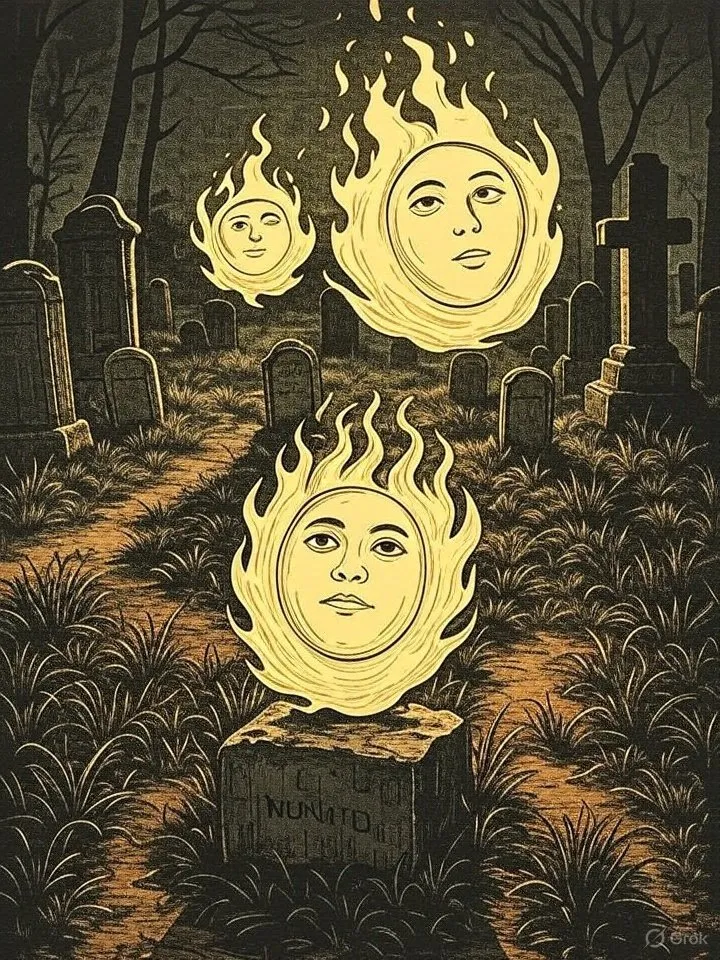
It was then that she saw it: a tiny ball of fire hovering above a new grave. The flame danced with an otherworldly light, its color shifting between blue and green as if infused with the night sky itself. Kikuno's heart skipped a beat; she recognized the Hitodama.
She approached slowly, not wanting to startle the spirit, but it did not move or respond to her presence. Instead, it seemed to be absorbing the light around it, growing brighter by the second. A small trail of fire sprang from its base, like a tiny comet blazing across the darkness.
Kikuno felt a shiver run down her spine as she realized that this was no ordinary Hitodama. It signified not death but life – a new soul emerging into the world. The elderly woman watched in awe as the flame pulsed and grew, filling the air with its soft light.
As she stood there, transfixed by the spectacle, Kikuno felt her own heart fill with a sense of wonder. In that moment, she knew that the Hitodama was not just a harbinger of death but also a symbol of transformation – the passing from one state to another.
The flame continued to dance above the grave, its light growing stronger by the minute. Kikuno felt her eyes grow heavy with sleep as she gazed upon this wondrous sight. The villagers would say later that on that autumn evening, Kikuno had been chosen to bear witness to a miracle – a soul's first breath in the world of the living.
As the Hitodama finally vanished into the night sky, leaving behind only a faint scent of smoke and dew, Kikuno knew that her life was forever changed. And though she would live many years beyond that moment, the memory of the little ball of fire would stay with her always – a reminder of the mysterious bond between the living and the dead.