
Name Meaning
Overview
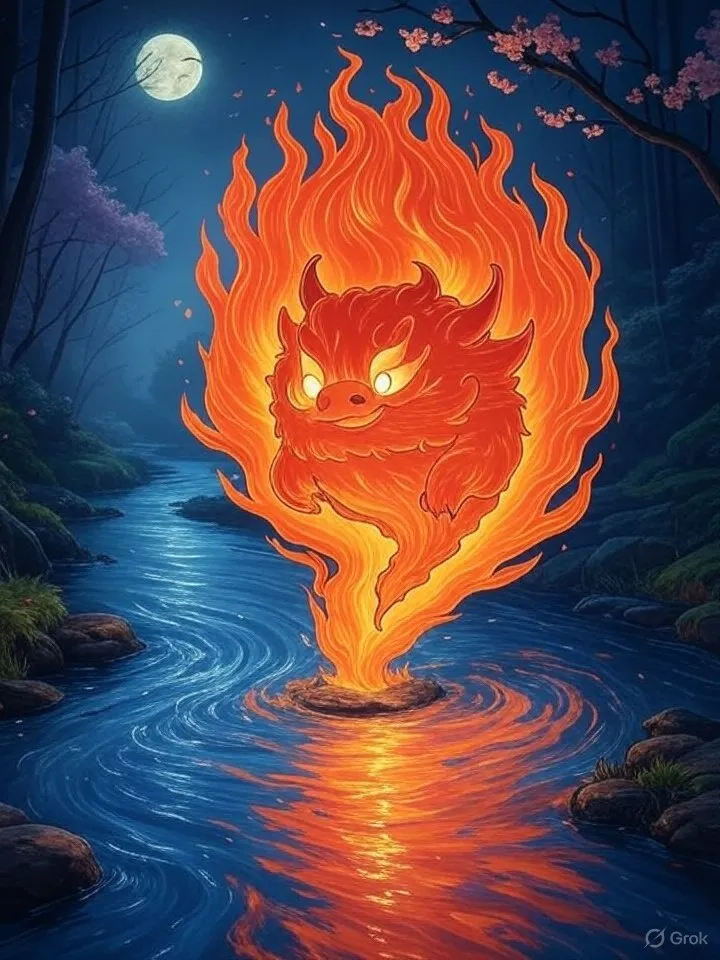
Asobibi (遊火) can be translated as “wandering fire” or “playful flame.” It is a strange and silent atmospheric phenomenon recorded in the countryside of Kōchi Prefecture.
- Asobi (遊び) = Play or wandering
- Bi (火) = Fire → “Playful Fire”
Origin
- Originates from regional folklore in Kōchi Prefecture on the island of Shikoku.
- Linked to atmospheric ghost lights and fireball yōkai, often appearing near rural roads or fields at night.
Appearance
- Seen as a small flame or fireball, glowing softly in the darkness.
- Appears to flicker, drift, or hover just above the ground.
- Sometimes said to have a playful, teasing motion—as if it’s leading travelers astray.


Behavior
- Does not harm people directly but may confuse or lead them off their path.
- Appears most often in humid, quiet nights near rice fields or forested roads.
- Vanishes if approached too closely or stared at for too long.
Symbolism
- Represents the mystery and fragility of natural spirits in rural Japan.
- Considered one of many forms of onibi or atmospheric ghost lights.
- Serves as a gentle warning to travelers to respect unseen forces of nature.

Illustrated folktale
The tale of Asobibi

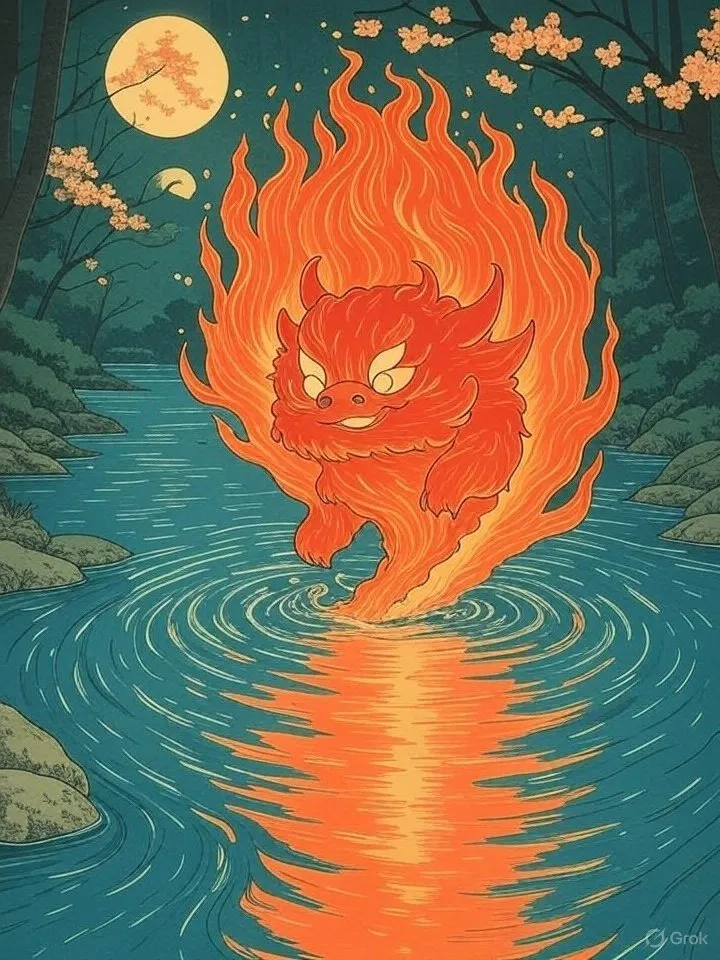
In the depths of Kōchi's rural heart, where rice fields swayed like golden seas under the summer sun, and forested roads whispered secrets to the wind, there lived a subtle companion to travelers: Asobibi, the fireball yōkai.
It was said that on quiet nights, when mist veiled the landscape and dew kissed the earth, Asobibi would manifest as a soft glow, dancing above the ground like a court jester. Some claimed to have seen it hovering over rural roads, beckoning wayfarers with an enigmatic grin, while others whispered of encounters in abandoned fields, where Asobibi's flickering flame seemed to lead them astray.
One evening, a weary traveler named Emiko found herself lost in the darkness of the forest. The moon, now but a sliver, cast long shadows that seemed to writhe like living things. Her footsteps echoed off the trees as she navigated the winding path, searching for the village lights that promised warmth and comfort.
As the night deepened, a tiny fireball appeared before her, hovering just above the earth. Emiko's heart quickened; it was said that Asobibi never led travelers to harm, but rather into encounters with themselves – reflections of their deepest fears and desires. The flame seemed to dance with an otherworldly playfulness, as if teasing her toward a hidden truth.
Transfixed by the spectacle, Emiko failed to notice the darkness closing in around her. The forest grew denser, its silences more oppressive. Asobibi's glow intensified, casting eerie shadows on the trees, until it seemed that the yōkai was devouring the very light of the world.
Suddenly, a gust of wind extinguished the flame, plunging Emiko into darkness. She stumbled forward, desperate to find her way back to civilization. The forest seemed to have shifted its contours; she felt lost once more.
Days passed before Emiko returned to the village. Her friends and family welcomed her with open arms, but they sensed a quiet unease about her – as if something had awakened within her during those fateful hours in the forest.
It was said that Asobibi had whispered a secret to Emiko: not just a warning to respect the unseen forces of nature, but a reminder that the mysteries of the land lay hidden in plain sight. From that day forward, Emiko walked with a newfound reverence for the quiet landscapes and their subtle guardians – aware of the delicate balance between human presence and the whispered whispers of Asobibi's flame.
And on humid nights, when mist veiled the rice fields and forested roads shrouded the darkness, travelers would swear they saw a small fireball dancing above the earth – Asobibi, beckoning them toward encounters with their own deepest selves.