
Name Meaning
Overview
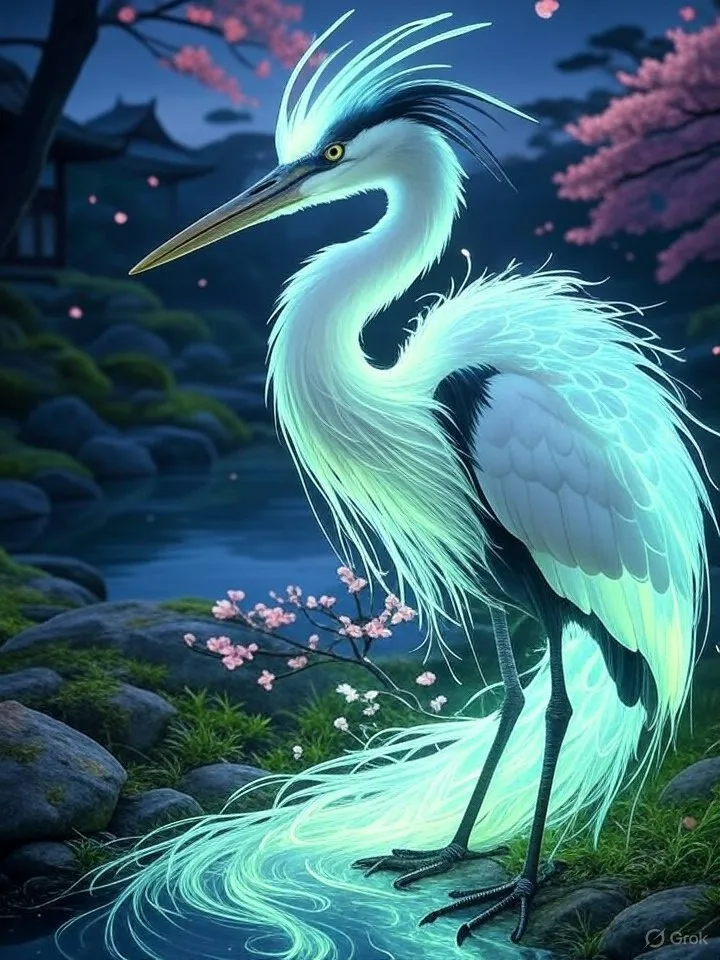
Aosaginohi (青鷺の火) translates to “Fire of the Blue Heron.” It is a glowing, ghostly heron said to appear on humid nights near rivers and swamps.
- Aosagi (青鷺) = Blue Heron
- Hi (火) = Fire → “Blue Heron Fire”
Origin
- Appears in yōkai literature as a transformed or aged heron whose soul has become spiritual flame.
- Linked to natural phenomena like foxfire and atmospheric ghost lights.
Appearance
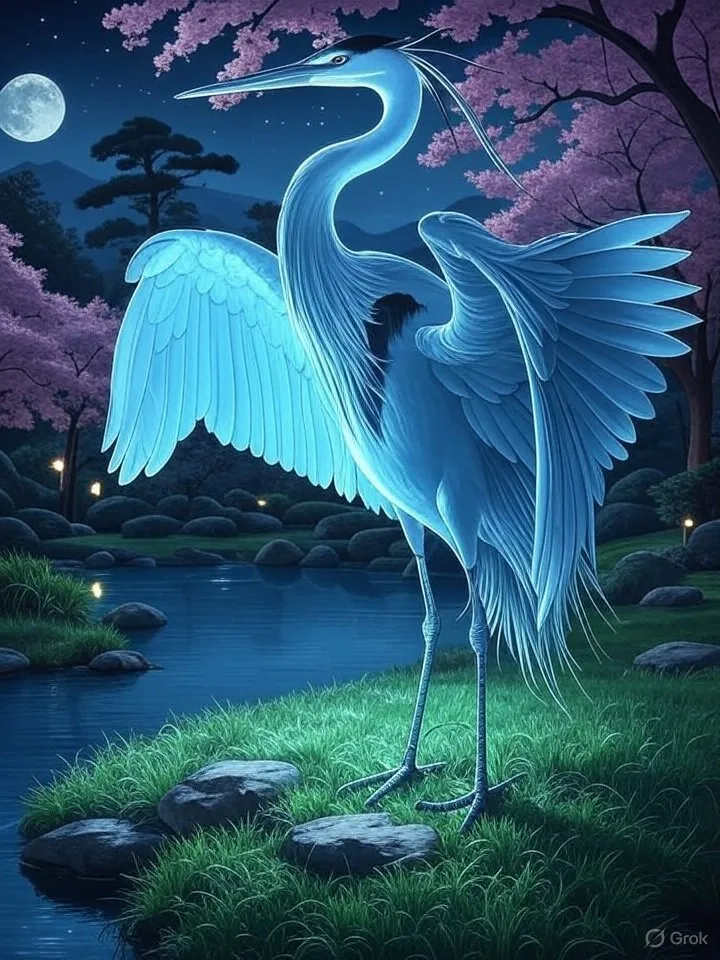
- A large heron with luminous, pale blue feathers that glow faintly in the dark.
- Leaves a soft trail of ghostly fire or sparkles as it walks or takes flight.
- Eyes may shimmer, and it is surrounded by an aura of unnatural stillness.

Behavior
- Appears silently and disappears just as quietly, often mistaken for a ghostly flame or illusion.
- It is not known to attack or curse but is often interpreted as a spiritual omen.
- Witnesses say it seems to walk between the worlds of nature and spirit.
Symbolism
- Represents the beauty and transience of nature and death.
- May symbolize an animal that has crossed into the supernatural due to age or wisdom.
- Often linked to mystical animal transformations in Japanese folklore.
Illustrated folktale
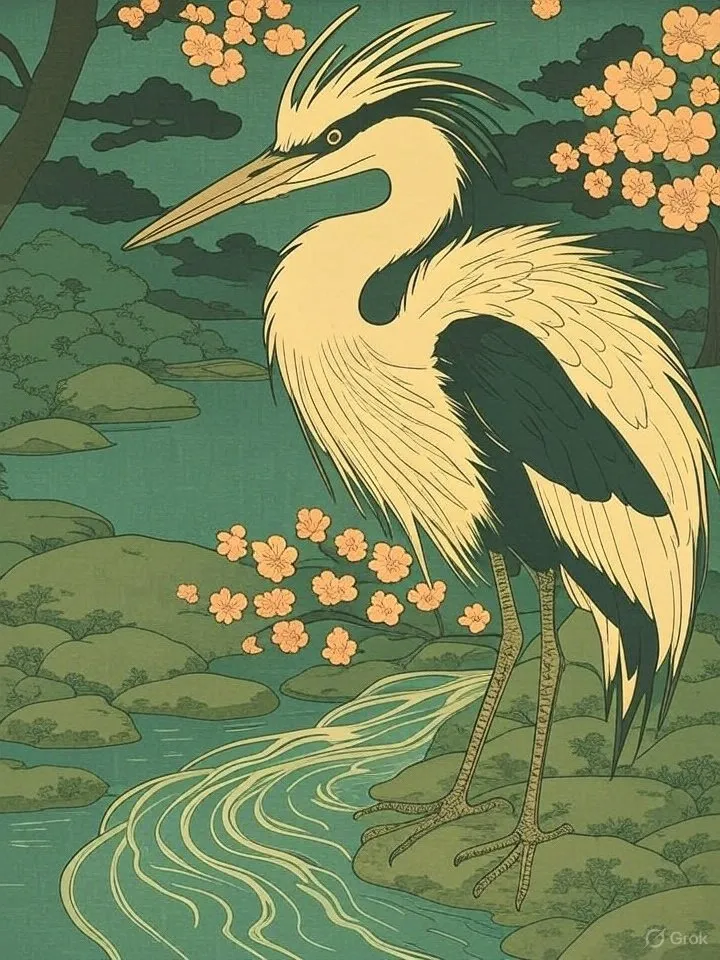
The tale of Aosaginohi

In the mist-shrouded hills of rural Akakawa, where cherry blossoms bloomed with eerie silence, there lived an elderly heron named Kaito. For decades, he had waded through the village's rice paddies and meandered along its mountain streams, a steadfast guardian of nature's cycles.
As autumn's departure whispered across the landscape, Kaito began to feel the weight of his years. His once-luminous feathers dulled, like watered silk left too long in the sun. His eyes, once bright as morning dew, now shone with a soft, ethereal light – a harbinger of transformation.
One evening, as the village's fires dwindled and darkness claimed the sky, Kaito vanished into the shadows. He wandered to the peak of Mount Akakawa, where wind-swept trees creaked in mournful tones. There, amidst a tangle of moss-covered boulders, he found an ancient tree, its bark etched with lines like a hermit's scroll.
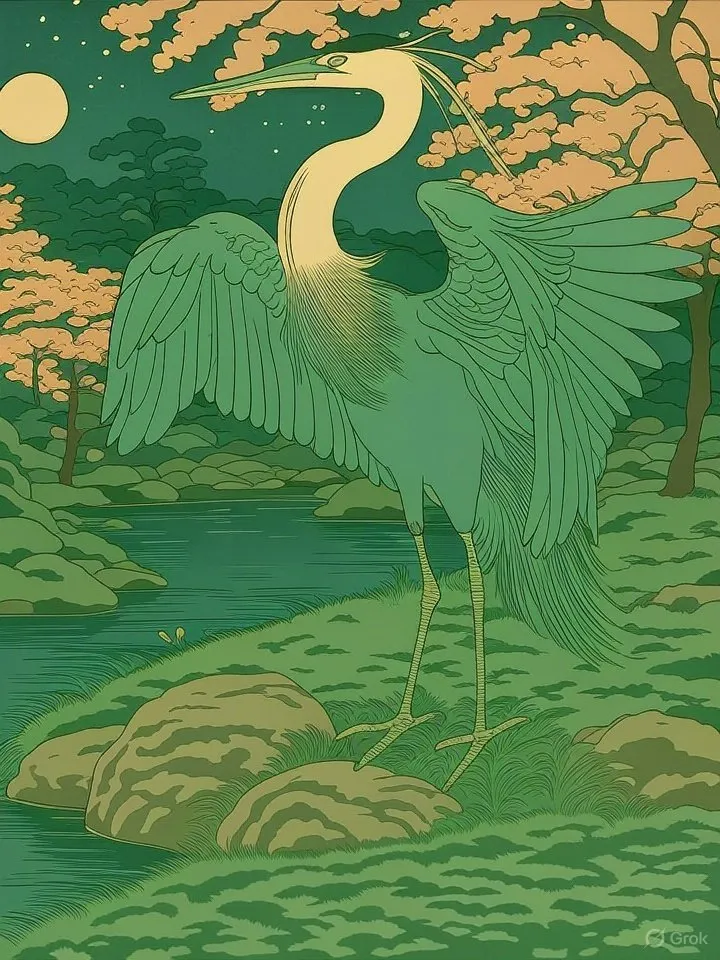
As Kaito drew near, his form began to shimmer and dissolve. His feathers unraveled into sparks that danced around him, illuminating the air with a soft blue fire. His wings unfolded, their delicate membranes glowing like ghostly fans. The wind whispered secrets in his ear, as if summoning an ancient wisdom.
Transfigured, Kaito stood as Aosaginohi – a being of luminescent flame and wispy form. He gazed out upon the world below, where humanity toiled amidst life's cycles: birth, growth, decay, and rebirth. The wind whispered his name on its breath, and Kaito felt an unearthly connection to the land and all that dwelled within it.
The villagers below reported a spectral light flickering across their valley – a beacon of mystical significance. Some believed Aosaginohi walked between worlds, guiding lost souls or carrying whispers from the beyond. Others claimed he portended change: transformation, renewal, or perhaps even the balance of life and death.
Yet, to those attuned to nature's rhythms, it was clear that Kaito had become a bridge between two realms – a guardian of the threshold where mortal life meets eternal mystery. His soft trail of sparkles left behind whispered secrets on the wind, reminding all who witnessed his passing: that even in departure lies a deeper connection to existence.
And so, as winter's snows veiled the village and its stories, whispers of Aosaginohi spread – a testament to the transience and beauty of life, as embodied by this ageless heron.