
Name Meaning
Overview
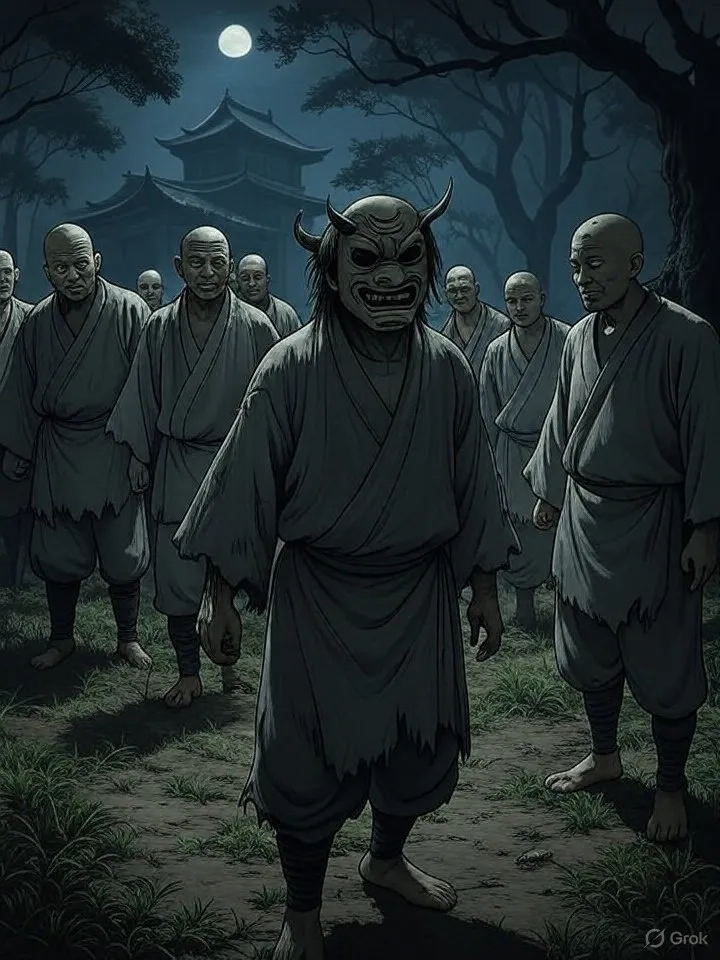
Yadōkai (夜道怪) roughly translates to "night path apparitions," often interpreted as corrupt or wayward monks turned yokai.
Origin
- Rooted in Buddhist folklore and moral teachings.
- Linked to monks who broke their vows or abused their spiritual roles.
- Stories passed down as warnings to maintain virtue.
Appearance
- May resemble ragged monks or shadowy human figures.
- Eyes may glow, and garments may flutter unnaturally.
- Can shift forms to confuse or frighten travelers.
Behavior & Myths
- Appear at night on rural paths or temple grounds.
- Mislead or harass pilgrims and the faithful.
- Some legends claim they drain energy or curse those they encounter.
Symbolism
- Represents spiritual corruption and betrayal of sacred duty.
- Serves as cautionary tale for religious integrity.
- Warns of hidden dangers along the spiritual path.

挿絵付き昔話
Yadōkai の物語

In the moonlit hours when shadows danced upon the temple grounds, a lone pilgrim named Kaito sought refuge from the scorching summer air. His worn sandals carried him along the winding path, his eyes fixed on the distant spires of Kumano-jinja. As he walked, the rustling of leaves and snapping of twigs beneath his feet seemed to echo through the stillness.
Suddenly, a gust of wind buffeted Kaito, sending his prayer beads flying into the darkness. The pilgrim bent to retrieve them, but as he rose, he felt an unsettling presence lurking just out of sight. A chill crept up his spine, and his breath quickened.
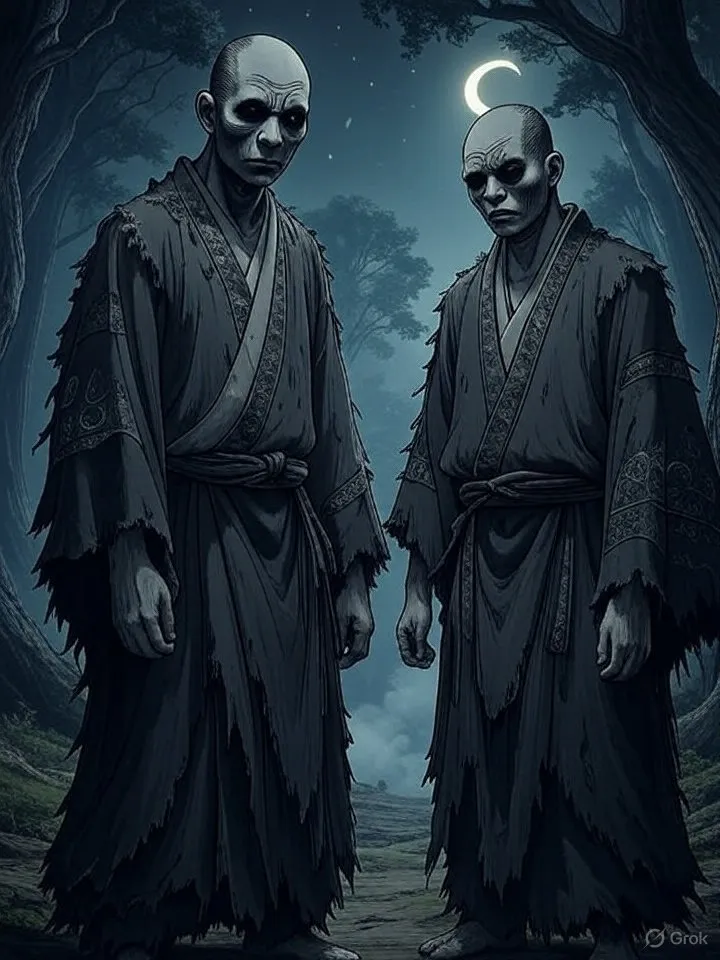
A figure emerged from the shadows – a ragged monk with eyes aglow like lanterns in the night. His tattered robes billowed behind him, as if stirred by an unseen wind. Kaito's heart skipped a beat as he recognized the sign of Yadōkai: a harbinger of spiritual corruption and betrayal.
As the pilgrim watched in trepidation, the monk began to shift and writhe, his form blurring like a reflection on rippling water. The eyes gleamed brighter still, illuminating the darkness with an otherworldly light. Kaito felt himself drawn toward the Yadōkai, as if by some unseen force.
"Turn back, traveler," the monk's voice whispered on the wind. "You seek spiritual solace, but your heart remains impure." The words dripped with malevolent intent, and Kaito stumbled backward, his mind reeling.
As he regained his footing, the pilgrim noticed a subtle change in the environment. The trees seemed to lean in, their branches tangled above him like skeletal fingers. A faint hum of chanting drifted through the air, an eerie echo of the temple's evening prayers.
Kaito realized that the Yadōkai sought not only to mislead but also to feed on the pilgrim's very essence. He recalled the teachings of his sensei: "A heart consumed by ego and desire is vulnerable to the whispers of darkness." With newfound resolve, Kaito steeled himself against the Yadōkai's insidious charms.
He called upon the blessings of Amaterasu, goddess of the sun, and began to chant a mantra of purification. As his voice rose above the shadows' mutterings, the wind died down, and the trees straightened their twisted limbs. The Yadōkai let out a defeated shriek, its form dissipating like smoke on the breeze.
Breathless and shaken, Kaito quickened his pace along the temple path. He knew that the true test lay not in avoiding the Yadōkai but in resisting its influence, that he might remain steadfast on his spiritual journey. And so, with each step, he fortified his heart against the shadows' siren call, guided by the quiet wisdom of the ancient traditions.