
Name Meaning
Overview
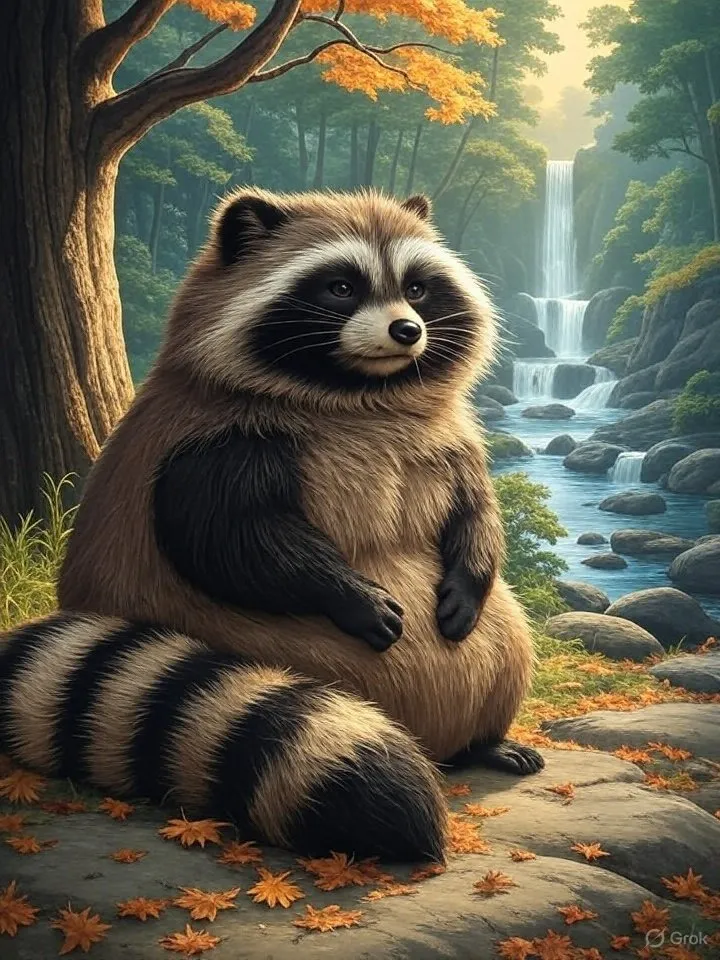
Tanuki (狸) is the Japanese word for a native species of raccoon dog, but in folklore, it refers to a supernatural creature with shape-shifting powers.
Origin
- Deeply rooted in Japanese folklore and Shinto traditions.
- Has become a popular character in Japanese art, literature, and statues.
- Associated with trickery, transformation, and good fortune.
Appearance
- Looks like a pudgy raccoon dog with a jovial expression.
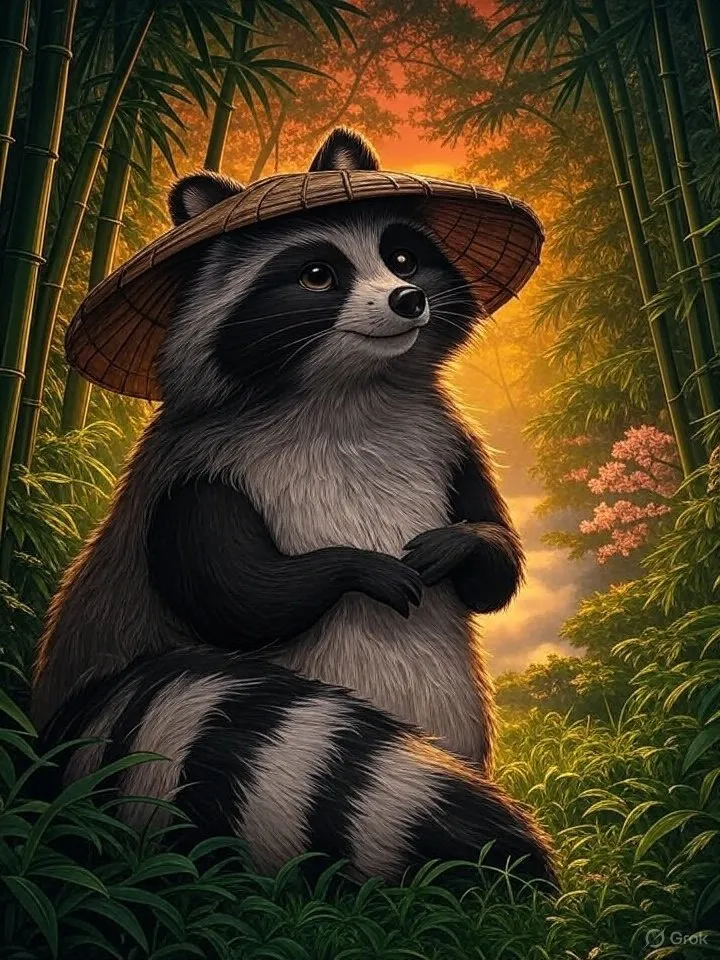
- Often shown with a straw hat, sake bottle, promissory note, and a large belly or testicles.
- May appear in human form or disguise itself as everyday objects.
Behavior & Myths
- Master of illusion and transformation—can become people, teapots, or even entire buildings.
- Loves sake and mischief but generally not malevolent.
- May trick travelers or merchants but often ends stories in comical or harmless ways.
Symbolism
- Represents joy, trickery, prosperity, and playful chaos.
- Statues of tanuki are often placed at shops and restaurants for good luck.
- A symbol of the unexpected and unpredictable in daily life.

挿絵付き昔話
Tanuki の物語

In the village nestled between two great mountains, where cherry blossoms bloomed in every corner and koi swam in the quiet streams, there lived a tanuki named Taro. He was as jovial as his name suggested, with a belly round as the moon and a heart full of mischief.
Taro loved nothing more than to while away the evenings at the local sake brewery, sipping on rice wine and spinning tales with the brewmaster. His stories were always of transformation and trickery, of turning stones into silk and selling them for fortunes. The villagers would laugh and gasp in equal measure, their faces aglow with wonder.
One autumn evening, as the harvest moon hung low in the sky, a young samurai named Kaito rode into town on his noble steed. He was a stern warrior from a neighboring village, tasked with collecting taxes from the local merchants. Taro watched with great interest as Kaito dismounted and approached the sake brewery.
"Good evening, honorable brewmaster," Kaito said, bowing low. "I've come for the taxes owed to our lord."
The brewmaster trembled at the samurai's words, but Taro saw an opportunity. With a wink, he transformed himself into a sturdy teapot, complete with steam rising from his spout and a saucer bearing an intricate design.
"Ah, here comes our guest!" the brewmaster exclaimed, ushering Kaito inside. "Try some of our finest sake, sir – it's said to have healing properties."
Kaito hesitated at first, but the brewmaster's warm smile won him over. As he poured a cup for himself and Taro (now in teapot form), he asked about the strange tanuki who had been seen lurking around town.
"Ah," the brewmaster chuckled, "that's just old Tanuki-san playing tricks on us again! He's always up to some mischief or another."
Kaito laughed and took a sip of his sake. Taro watched from within his teapot disguise as the samurai's guard dropped, ever so slightly.
In the night that followed, while Kaito slept off his meal, Taro transformed back into his true form and crept to the samurai's bedside. He scribbled a comical poem on a promissory note, one that went something like this:
"The taxes of old are not what they seem, A samurai's burden weighs heavy on the dream. Why not let loose and dance with me, Under moonlight, in wild glee?"
Taro tucked the note beneath Kaito's pillow and vanished into thin air. The next morning, as the samurai collected his gear to leave, he found the poem staring up at him.
A smile crept across Kaito's face. "I suppose," he said to the brewmaster, "our village is indeed a magical place." From that day forward, whenever the young warrior came to collect taxes, Taro would be there in spirit – reminding everyone of the joy and playfulness hidden within even the most mundane tasks.
As for Kaito, he grew wiser with each passing year, learning to appreciate the quirks and charms of life. And though he never forgot his brush with Tanuki magic, the villagers claimed it was not the samurai who had changed – but the very air itself.