
Name Meaning
Overview
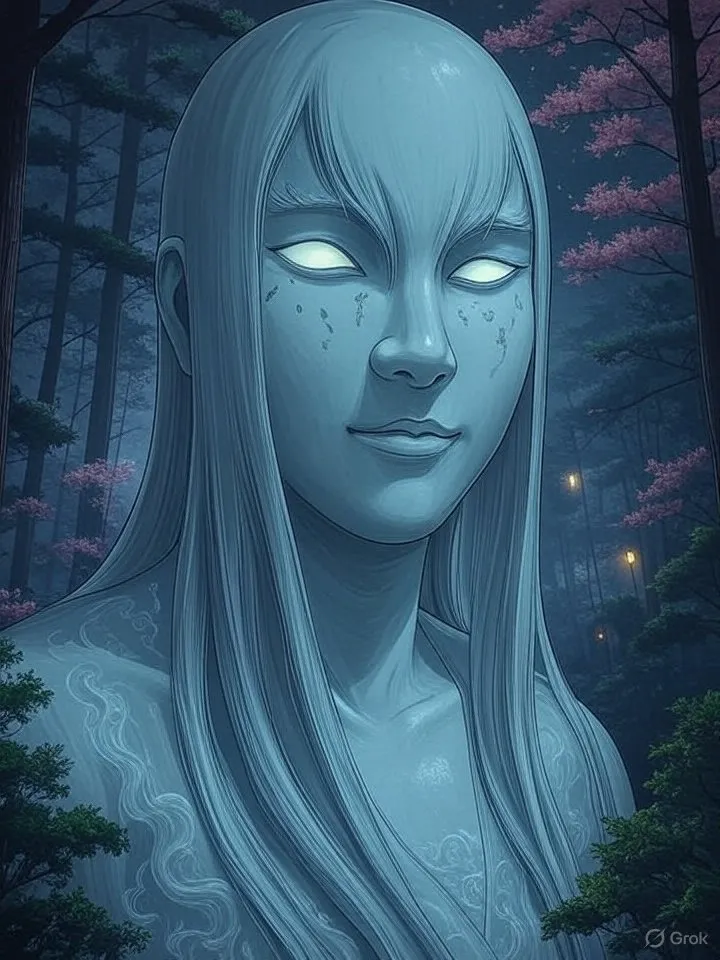
Ōkamuro (大顔) literally means "giant face" in Japanese. It is a supernatural apparition that appears suddenly in front of doors or windows.
- Ō (大) = Big, giant
- Kamuro (顔) = Face
Origin
- Found in Edo-period ghost stories and kaidan collections.
- Thought to haunt old homes or buildings late at night.
- Often appears in flashes or when the door is opened suddenly.
Appearance
- A large disembodied human face, with exaggerated or unsettling features.
- Its expression may be blank, grinning, or contorted in anger.
- Appears out of nowhere, taking up the whole doorway.
Behavior & Myths
- Causes fear, paralysis, or unconsciousness in those who encounter it.
- May be a form of ghost or manifestation of spiritual energy.
- Appears only briefly, leaving people shaken and confused.
Symbolism
- Represents fear of the unknown or invasion of personal space.
- Can be seen as a warning or omen.
- Also used as a ghost-story motif in kabuki and literature.

挿絵付き昔話
Ōkamuro の物語

In the sleepy town of Shirakawa, where cherry blossoms bloomed in every corner and misty rain veiled the streets at dusk, there stood an ancient dwelling known as the Hakone Estate. For generations, its wooden beams had borne witness to laughter, tears, and whispers of love. Yet, on nights when the moon hung low, a chill crept into the air, and the townsfolk would whisper of the Ōkamuro.
One evening, a young woman named Emiko returned home from gathering yew leaves for her mother's traditional tea blend. As she pushed open the creaking door, a sudden draft swept past her, carrying with it an unsettling chill. The doorway seemed to darken, as if night itself was seeping in. And then, without warning, the Ōkamuro appeared.
Its face, a twisted mockery of human visage, filled the entire portal. Emiko froze, paralyzed by fear, as the Ōkamuro's gaze bored into her very soul. Its countenance shifted – from a blank stare to a grotesque grin, and then, in an instant, contorted in a snarl that seemed to rip at the very fabric of the air.
Time itself appeared to warp, compressing into a single, piercing moment. Emiko's breath caught in her throat as she felt the weight of the unknown settling upon her like a shroud. The world narrowed to the Ōkamuro's face, its features blurring and shifting until they became an unrecognizable mass.
When the apparition vanished as suddenly as it appeared, leaving behind only a faint scent of damp earth and decay, Emiko crumpled onto the threshold. Her body shook with sobs, as if the weight of the Ōkamuro's gaze had left her breathless. The wind died down, leaving an oppressive silence that seemed to seep into her very marrow.
Days passed, and Emiko found herself waking in the dead of night, her heart racing at every creaking beam or whispered rumor of the Ōkamuro's presence. Her family and friends tried to reassure her, but she knew – as did the townspeople – that the Ōkamuro was a harbinger of something far more sinister than mere mortal fear.
For in Shirakawa, where cherry blossoms bloomed in every corner, it was said that the Ōkamuro's presence foretold not only personal dread but also an invasion of one's very space – a disruption of the delicate balance between the world and its dwellers. And when the night wind whispered through the Hakone Estate's empty halls, Emiko knew she had glimpsed something far beyond mortal understanding.
The townsfolk would say that on certain nights, when rain veiled the streets and moonlight struggled to penetrate, you could still see Emiko standing at the threshold of her family's estate, frozen in terror as the Ōkamuro's face seemed to seep into the darkness, a manifestation of the unknown that left its mark upon her very soul.