
Name Meaning
Overview
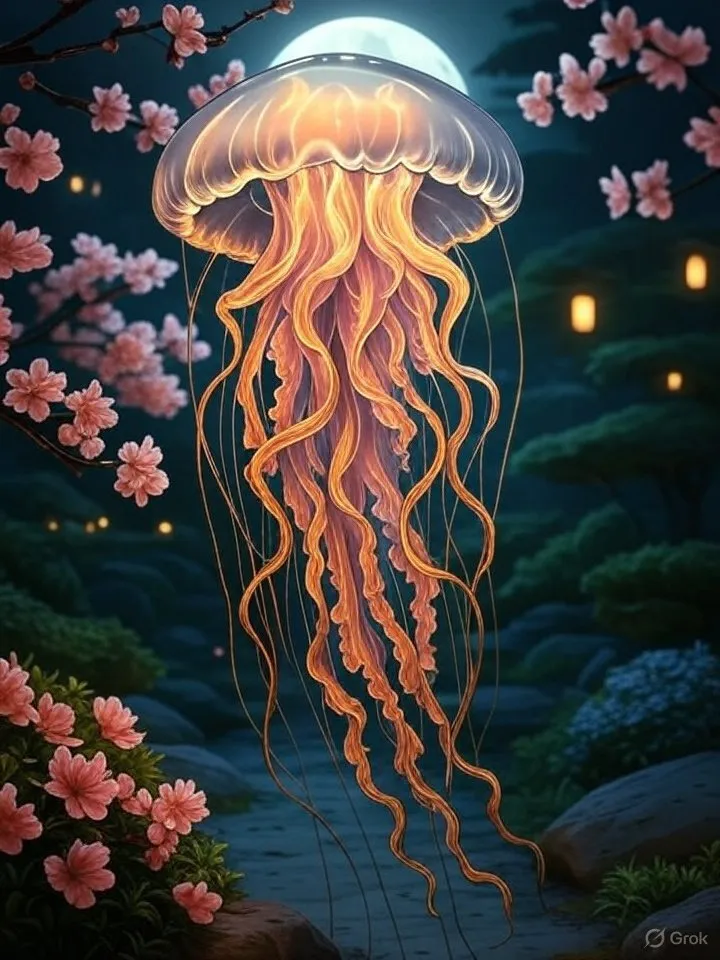
Kurage-no-hinotama (クラゲの火の玉) translates directly to "jellyfish fireball," reflecting its ghostly, glowing, floating appearance at night.
- Kurage = Jellyfish
- Hinotama = Fireball, will-o'-the-wisp
Origin
- Reported in coastal and fishing villages where eerie lights were spotted hovering over water.
- Linked to both natural phenomena and ghost sightings in local lore.
- Mentioned in Edo-period collections of strange sightings.
Appearance
- Glowing, translucent orb resembling a jellyfish.
- Appears to drift gently, undulating like it swims through air.
- Sometimes said to leave a faint trail or pulse of light.
Behavior & Myths
- Seen as a bad omen or sign of nearby death.
- Thought to be the soul of a drowned person or spirit of the sea.
- Disappears if approached, like other hitodama or atmospheric ghost lights.
Symbolism
- Represents ethereal beauty and the mystery of oceanic spirits.
- A visual metaphor for fleeting life and ghostly presence.
- Symbolic of unresolved death or tragedy at sea.

挿絵付き昔話
Kurage-no-hinotama の物語

In the village of Akakawa, where the sea whispered secrets to the wind, there lived an old fisherman named Kaito. His eyes had seen many moons rise over the waves, and his hands had pulled countless nets from the dark depths. Yet, in all those years, he never forgot the day a Kurage-no-hinotama appeared above the water.
It was a summer evening, the sun's fiery edges sinking slowly into the horizon. Kaito stood on the beach, watching as the breeze rippled the surface of the sea. His thoughts were elsewhere, however, for his son had gone out to fish that morning and never returned. The villagers searched far and wide, but there was no sign of Taro's boat or its occupant.
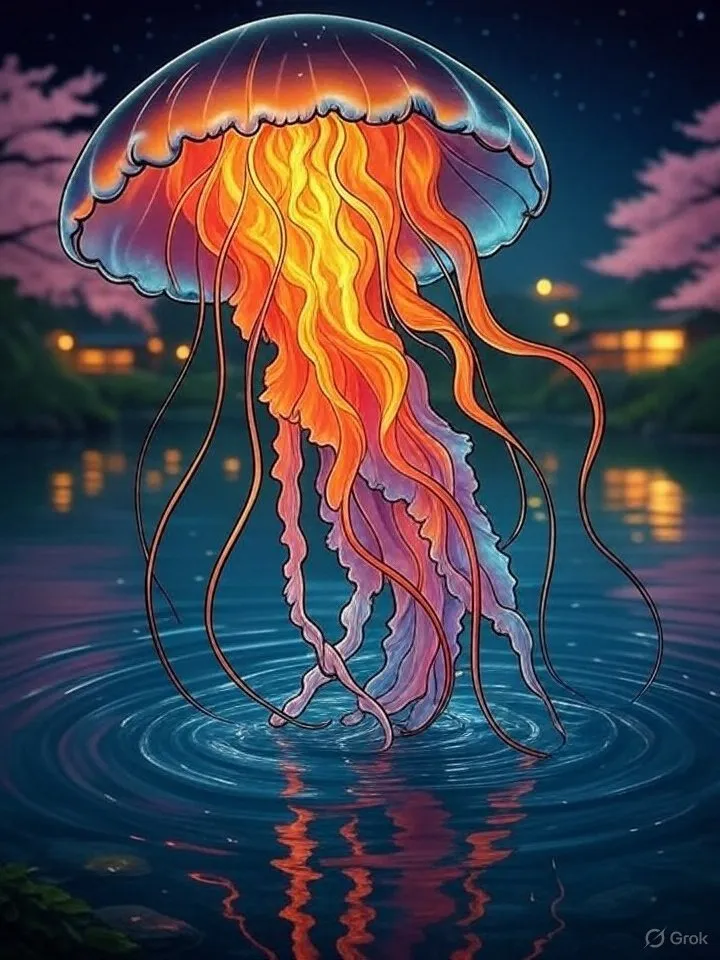
As the stars began to twinkle in the darkening sky, a soft glow appeared above the waterline. It hovered, undulating like a jellyfish, leaving behind a faint trail of light. Kaito felt his heart heavy with foreboding as he recognized the Kurage-no-hinotama. This was no common phenomenon, but an omen – a sign that something was amiss in their little village.
The orb drifted closer to the shore, and Kaito could sense its gentle pulsing like a lullaby from beyond the grave. He approached it cautiously, not wanting to disturb the restless spirit. Yet, as he drew nearer, the light began to fade, and the Kurage-no-hinotama vanished into the darkness.
That night, Kaito couldn't sleep. His mind was plagued by visions of his son's face, pale and cold, staring back at him from beneath the waves. The next morning, a fisherman brought news that Taro's boat had been found, wrecked on a hidden reef near the coast of a nearby island.
As Kaito walked along the beach, he noticed something strange: tiny shells, carried by the tide, lay scattered around the spot where the Kurage-no-hinotama had appeared. In each shell, a small note was tied with a thin thread – notes from his son's own hand. They told of a great storm brewing, and how Taro had been swept out to sea in its wake.
Kaito felt his heart break as he read the final message: "I'm sorry, Father. I'll come back for you." The old fisherman knew then that his son was not lost forever, but rather trapped between worlds – a spirit of the sea, now one with the Kurage-no-hinotama.
From that day on, when the villagers saw the glowing orb hovering above the water, they whispered prayers for Taro's soul, and for the safety of all who sailed upon their waters. And Kaito would sit on the beach, watching the sea, his eyes searching for a glimpse of his son – now a spirit, forever tied to the mystery of the Kurage-no-hinotama.