
Name Meaning
Overview
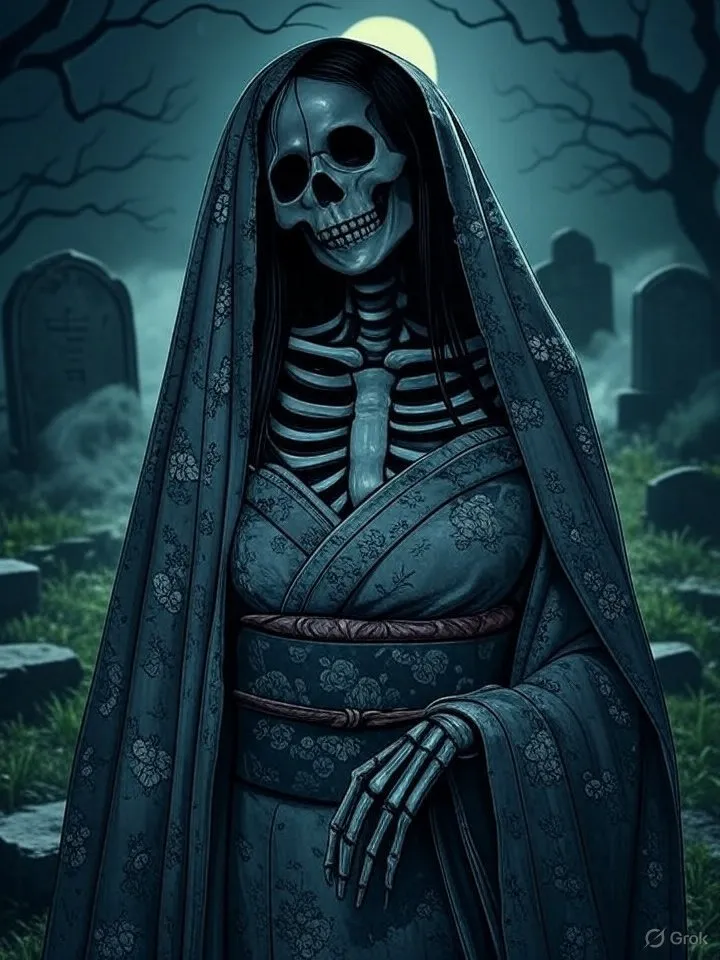
Hone-onna (骨女) translates directly to "bone woman" and is a spectral yokai who disguises herself as a beautiful woman but is actually a walking skeleton.
- Hone (骨) = bone
- Onna (女) = woman
Origin
- Popular in Edo period ghost stories and woodblock prints.
- Appears in the famous yokai collection Konjaku Hyakki Shūi by Toriyama Sekien.
- Often tied to tragic romances and lingering spirits of devotion.
Appearance
- Appears as a beautiful, ethereal woman under moonlight.
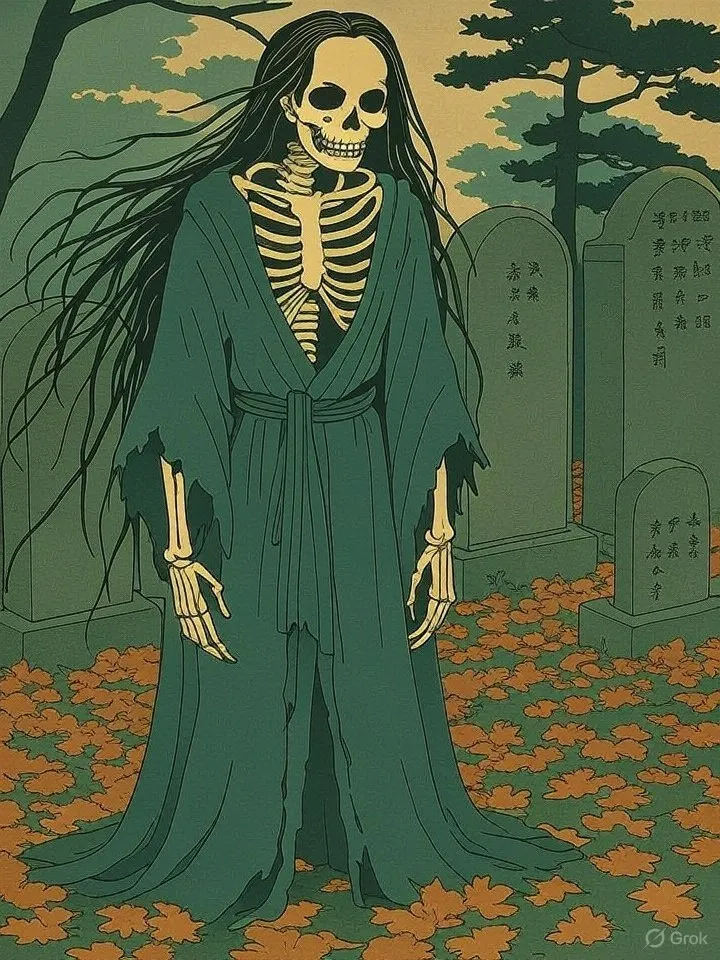
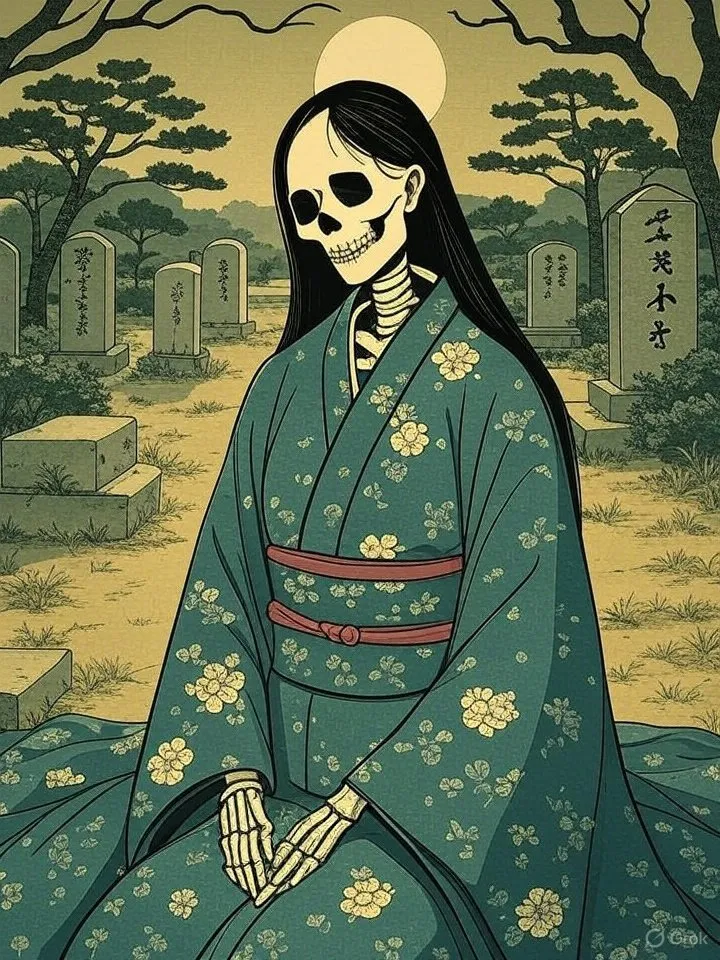
- Her true form is revealed in mirrors or upon close inspection: a skeleton clad in rotting kimono.
- Sometimes shown with only her face remaining youthful while the rest is bones.


Behavior & Myths
- Visits the home of a former lover night after night.
- The man, under her spell, sees her as young and beautiful.
- Her presence slowly drains his life until he withers away.
Symbolism
- Symbol of love beyond death and the dangers of clinging to the past.
- Represents beauty as an illusion and the inevitability of death.
- Used in moral tales to warn against obsession and spiritual blindness.
挿絵付き昔話
Hone-onna の物語

In the village of Akakawa, where cherry blossoms bloomed in every season and moonlight glistened on rice paddies, there lived a young artist named Kaito. His brushes danced with colors, capturing the very essence of nature's beauty. But amidst his passion for art, he harbored a deeper longing – to recreate the face of his lost love, Emiko.
Years ago, while strolling along the riverbank, Kaito had encountered Emiko, a gentle soul with hair as golden as autumn leaves and eyes as deep as the night sky. Their love blossomed under the same cherry blossom trees that now adorned the village. But fate, it seemed, had other plans. Emiko fell ill, and despite Kaito's devotion, she vanished into the darkness of death.
Kaito's heart remained with her spirit. Every evening, as moonbeams illuminated his studio, he'd pour his emotions onto canvas, striving to revive Emiko's likeness. Some said it was madness, but Kaito swore that one day he would enthrall his beloved in life once more.
One fateful night, under a full moon, the studio door creaked open. A delicate breeze rustled the screens, and an ethereal woman drifted inside. Her countenance gleamed with a soft luminescence, as if moonlight had taken human form. Kaito's heart skipped a beat; he beheld Emiko reborn.
Entranced by her beauty, Kaito failed to notice the subtle changes that followed each visitation: Emiko's once-lustrous hair now hung in tangled skeins, her skin took on an increasingly pale hue, and the curves of her body began to lose their lissome shape. Yet, he refused to acknowledge these signs; his love had rendered him blind.
With each night, Kaito grew weaker. His once-vibrant paintings withered like autumn leaves. As he gazed at Emiko's face, now gaunt and decaying, her beauty seemed more striking still. The brushstrokes of life's paintbrush faltered, leaving only hollow strokes on the canvas.
In desperation, Kaito sought out the wise old nun who dwelled in a nearby temple. Her eyes had witnessed countless tales of love's redemptive power and its dark consequences. "Your love has become an anchor to death," she warned him gently. "Emiko's spirit is bound by her devotion to you, but at what cost? Your soul will wither like autumn leaves, leaving naught but shadows where your heart once was."
The words pierced Kaito's stubbornness like a ray of sunlight piercing fog. He beheld Emiko for the truth – in mirrors, in lanterns' gentle glow. Her visage still radiant, yet the rest of her form lay exposed: a skeleton clad in tattered kimono.
Overwhelmed by sorrow and regret, Kaito's brushstrokes stilled. The spirit of Emiko vanished as swiftly as it had appeared, leaving behind only memories and a whispered promise – that love can transcend even death itself, but obsession holds no such power.
From that day on, the village elder would whisper to young lovers: "Love beyond death is a beauty born from shadows, not light. Cherish each fleeting moment, lest you lose yourself in the darkness of devotion."